February 24, 2016

Cross-Country by Amtrak

A recent business trip took me to Dallas on a crowded, turbulent 3 ½ hour flight from LaGuardia.  But the return trip was a real treat:  2 days and nights on Amtrak, for free.
Riding a lot of Acela trains in the Northeast Corridor, I’ve built up a ton of AmtrakGuest Rewards® points, augmented by their co-branded credit card.  So when I checked my calendar and the Amtrak website, I saw an opportunity to enjoy a leisurely ride home in a full bedroom, meals included, gratis.
The long distance trains I rode from Dallas to Chicago (The Texas Eagle) and Chicago to
Washington DC (The Capitol Ltd) were all “Superliners”, ie double-deck cars with a variety of accommodations, including coaches and sleeping cars.

Each train also had a diner and an observation car, though the sightseeing through Texas, Arkansas, Missouri and Illinois wasn’t exactly memorable.  But the second leg of the trip thru the hills and river 
Observation Car
Photo by Nick Sweeting
valleys of Pennsylvania and Maryland was gorgeous. “Fly over” country sure looks different from an elevation of about 20 feet.


My bedroom was equipped with a big couch that folded down into an almost queen-sized bed… surprisingly comfortable for sleeping.  The private commode doubled as a shower. 
Firing up my radio scanner, pre-set to the railroads’ frequencies, I followed the action as the conductor and engineer received instructions from a dispatcher hundreds of miles away.
The food was good… all cooked to order… and included in my first class fare.  Dining was communal, one of the fun parts of train travel:  getting to meet real folks from across the US, chatting about their travels, their work… everything except politics.
In Chicago and Washington DC, where I had time between train connections, I enjoyed Amtrak’s “Metropolitan Lounge” for first class passengers, complete with free Wifi, snacks
and priority boarding.  I also had time to explore those cities’ beautifully restored train stations jammed with commuters, Amtrak passengers, shops and restaurants.
To their credit, Amtrak does a great job with their money-losing long distance trains.  The service is truly First Class, the ride smooth and, for the most part, on-time (thanks to a heavily padded timetable).  We had only two small delays… one caused by another Amtrak train colliding with a truck at a grade crossing (no injuries), the other by a boulder on the tracks that needed to be removed.

Because demand is high and the supply of sleepers is low, fares for long distance Amtrak trains are pricey and booked many weeks in advance.  Roundtrip airfare from NY to Dallas is as low as $230.  But one-way on Amtrak is $299 in coach and $700+ in a roomette.  Of course with Amtrak it’s like getting two nights of hotel plus meals, but to me it’s well worth it.


So next time you’re planning a long distance trip, turn it into a journey.  Take the train!

January 31, 2016

Tolls, Taxes and Transportation

I hate to say “I told you so”, but…  Just as I’d predicted, Governor Malloy’s hand-picked Transportation Finance Panel has finally issued its recommendations for paying for the governor’s 30-year,  $100 billion transportation “plan”. 
First off, the Governor’s “plan” is not a plan but a wish-list of projects for all 169 towns and cities in the state.  It has been vetted by no one and has no priorities, (though CDOT
Commissioner Redeker says about two-thirds [$66 billion] would be for repairs and replacement of what we already have, not any grandiose schemes for monorails down the middle of I-95.)
Interestingly, as it began work last summer the Transportation Finance Panel wasn’t allowed to debate the merits of anything in the Governor’s “plan”, so all they could do was suggest how to fund the whole thing. 
Atop their newly issued report is a telling quote:  “If something’s worth having, it’s worth paying for.”  Duh!  But that’s a pretty soft sell on this mega-plan given the unpopularity of their funding suggestions:
  • ·       Raise the gasoline tax two cents a year for seven years
  • ·       Hike bus and rail fares 2.5% annually
  • ·       Introduce electronic tolls on highways with congestion (time of day) pricing.
  • ·       Land value capture at transit sites

That last idea is a doozey.  It suggests that if someone owns private land next to a new transit station and it appreciates in value, the increased taxes collected by the town should be shared with the state.
That is perilously close to last year’s Machiavellian bill that would have created a quasi-state agency, the Transit Corridor Development Agency (all of whose members would be appointed by the Governor) which would have the power of eminent domain on any land within a half mile of a bus or train station.  Though rejected, that idea is already being re-thought by OPM, so watch out this session.

But before you set your hair on fire… don’t worry.  All of this is moot.  Nothing is going to happen, and here’s why.
The Governor says that none of his panel’s proposals should even be discussed until there is a transportation “lock box” in place.  That won’t happen until November’s election and will depend on passage of a constitutional amendment ballot question.
Why the delay?  Because the Democrats in the legislature don’t want to have to vote on something as unpopular as tolls or taxes before the next election.
Meanwhile, even Governor Malloy seems distracted from his transportation mega-plans, as he is rumored to be lobbying for a cabinet seat in the Clinton administration come 2017. And the Presidential campaign season will doubtless see Governor Malloy on the road quite a bit on behalf of his could-be boss.


So don’t look for a widened I-95, high-speed rail or new deep-water ports anytime soon.  The legislature will be busy with more important things, like getting re-elected, before they can deal with funding the Malloy “plan”.

January 26, 2016

Don't Blame the Trucks


Driving to Hartford the other day (no, you cannot really get there by train) I saw a beautiful sight:  hundreds of trucks!  Yet, motorists hate trucks and mistakenly blame them for traffic congestion and accidents that cause hours of delays.
Readers of this column know I’m a “rail guy” and would love to see freight trains replace trucks, but that ain’t gonna happen anytime soon.  But as motorists we should not blame truckers for traffic woes of our own creation.
Check the facts and you’ll find most highway accidents are caused by motor cars, not the trucks.
Do trucks drive too fast?  Sure, but don’t we all?  Next time you’re on I-95 check who’s in the high-speed left lane and you’ll see cars, not trucks.
Should there be better safety inspections of trucks?  Absolutely!  But for every over-weight truck or over-worked truck driver there are doubtless hundreds of unsafe cars and equally road-weary warriors behind the wheel whose reckless disregard endangers us all.
Truckers drive for a living.  They are tested and licensed to far more rigorous standards than anyone else.  And because they drive hundreds of miles each day, overall I think they are far better drivers.  When’s the last time you saw a trucker juggling a cellphone and a latte like some soccer moms?
And remember… they’re not out there driving their big-rigs up and down the highway just to annoy us.  We put those trucks on the road by our voracious consumption patterns.  Every product we buy at stores large and small, including the very newspaper or iPad you hold in
your hand, was delivered by trucks.  Want fewer trucks on the road?  Just stop buying stuff.
By definition, trucks are high-occupancy vehicles.  Compare the energy efficiency of a loaded truck delivering its cargo to you in your “SOV” (single occupancy vehicle), even if it is a hybrid.  Only rail offers better fuel efficiency.
Why are trucks jamming our highways at rush hour?  Because merchants require them to drive at those times to meet the stores’ delivery timetable.  If big-box stores and supermarkets only took truck deliveries in the overnight hours, our highways would flow much better at rush hour. 
Truckers must use the interstates while passenger cars can chose among many alternate routes.  Why is the average distance driven on I-95 in Connecticut just eleven miles?  Because most of us drive the ‘pike for local, not interstate trips.
If we were smart enough to “value price” our highways (ie return tolling) we’d see fewer vehicles of all kinds on I-95, and those that were willing to pay for the privilege of motoring there would get real value in a faster ride.
I’m hardly an apologist for the trucking lobby.  But neither is it fair for us to blame anyone but ourselves for highway safety and congestion.  It’s the SOV crowd, not the truckers, who are to blame. 
Let’s be honest about this mess of our own making and stop trying to blame truckers as our scapegoat.  As the great philosopher Pogo once put it, “We have met the enemy and he is us!”

January 01, 2016

Speed Limits, Safety and Fuel Efficiency


Crawling along I-95 the other day in the usual bumper-to-bumper traffic, I snickered when I noticed the “Speed Limit 55” sign alongside the highway.  I wish!
Of course, when the highway is not jammed, speeds are more like 70 mph with the legal limit, unfortunately, rarely being enforced.  Which got me thinking:  who sets speed limits on our highways and by what criteria?
Why is the speed limit on I-95 in Fairfield County only 55 mph but 65 mph east of New Haven?  And why is the speed limit on I-84 just 55 mph from the NY border to Hartford, but 65 mph farther east in “the Quiet Corner”?  Why does the eastern half of the state get a break?
Blame the Office of the State Traffic Administration (OSTA) in the CDOT.  This body regulates everything from speed limits to traffic signals, working with local traffic authorities
(usually local Police Departments, mayors or Boards of Selectmen).
OSTA is also responsible for traffic rules for trucks (usually lower speed limits) including the ban on their use of the left hand lane on I-95 in most places.
It was the Federal government (Congress) that dropped the Interstate speed limit to 55 mph in 1973 during the oil crisis, only to raise it to 65 mph in 1987 and repeal the ban altogether in 1995 (followed by a 21% increase in fatal crashes),  leaving it each state to decide what’s best.
In Arizona and Texas that means 75 mph while in Utah some roads support 80 mph.  Trust me… having recently driven 1000+ miles in remote stretches of Utah, things happen very
fast when you’re doing 80 – 85 mph!
About half of Germany’s famed Autobahns have speed limits of 100 km/hr (62 mph), but outside of the cities the top speed is discretionary. A minimum of 130 km/hr (81 mph) is generally the rule, but top speed can often be 200 km/hr (120 mph).
Mind you, the Autobahn is a superbly maintained road system without the bone-rattling potholes and divots we enjoy on our highways.  And the German-built Mercedes and Audis on these roads are certainly engineered for such speed.
American cars are designed for maximum fuel efficiency in the 55 – 60 mph range.  Speed up to 65 mph and your engine runs 8% less efficient.  At 70 mph the loss is 17%.  That adds up to more money spent on gasoline and more environmental pollution, all to save a few minutes of driving time.
But an even bigger for the loss of fuel efficiency is aerodynamic drag, which can eat up to 40% of total fuel consumption.  Lugging bulky roof-top cargo boxes worsens fuel economy by 25% at interstate speeds.  So does carrying junk in your trunk (or passengers!):  a 1% penalty for every 100 pounds.
Even with cheaper gasoline, it all adds up!

December 23, 2015

Transportation Predictions for 2016

Everybody writes “year in review” stories.  But rather than dwell on the past, I’ve got the guts to predict the future!  Here’s what will happen in 2016 in the transportation world.
METRO-NORTH:    Slowly but surely, the railroad will drag itself out of the quagmire it’s been in since the Bridgeport, Spuyten Duyvil and Valhalla crashes.  On time performance will hold strong even through the winter, thanks to the dependable new M8 cars and mild weather.  Ridership will continue to climb, causing further crowding and SRO conditions on some trains.
STAMFORD GARAGE:     After waiting for its chosen developer (and Malloy campaign contributor) JHN Group to sign a contract two and a half years after being tapped for the massive TOD project, CDOT will pull the plug on its deal and replace the old garage on its own (taxpayers’) dime.
TOLLS & TAXES:   Governor Malloy’s quest for $100 billion to pay for his 20-year transportation plan will prove universally unpopular when his Transportation Funding Task Force finally issues its recommendations (originally due after Labor Day) in January. The panel will call for higher gasoline and sales taxes, tolls, motor vehicle fees and a slew of other unpopular ideas.  The legislature will react by slashing the Governor’s unrealistic plans, reluctant to have its fingerprints of anything the Task Force suggests.
EMINENT DOMAIN:          Governor Malloy will try again to impose state control over transit oriented development, reintroducing his stealth bill to create a Transit Corridor Development Agency (all of whose members he would appoint) with the power to seize any land within a quarter mile of a rail station. 
FLYING:       Returning to profitability, airlines will continue to squeeze more seats onto fewer flights, making flying an ordeal.  Frequent flyer rewards will be harder to get as desperate passengers will pay to ride in business or first class, leaving fewer seats for upgrades.
AMTRAK:     Acela will become increasingly popular, allowing the railroad to raise business fares.  Last minute seats will be harder to get, but the railroad will still refuse to expand service by buying new railcars.  Traditional “Northeast Corridor” trains will still be jammed as the railroad tries to compete with discount bus carriers.
HIGHWAYS:           With an improving economy and inadequate rail station parking, people will jam I-95 and the Merritt Parkway in even larger numbers, increasing commuting times further.  Gasoline prices will continue to decline thanks to cheap oil, sending even more people to the roads.
UBER WAFFLES:     State and city authorities will come down hard on car services like Uber and Lyft, imposing on them the same regulations and taxes now born by taxis and limos.  After “leveling the playing ground”, Uber-type services will raise fares, passing those costs on to passengers.

Will all of my predictions come true?  Check back in a year and we’ll see!  Meantime, happy traveling in 2016!

December 07, 2015

It's All About Transportation

While this column often is a rant about failing commuter rail service or an occasional rave for overdue investment in our highways, when you think about it, transportation is really an issue that affects many aspects of our lives.
JOBS:          If it wasn’t for transportation, 99% of us wouldn’t be able to get to our jobs.  It is thanks to Metro-North and yes, even I-95, that we can live in one place and work in another.  Imagine how your life would change if you could only live within walking distance of where you work.
These towns are in a "food desert"
FOOD JUSTICE:     The East-End of Bridgeport, our state’s biggest city, is a food desert.  For 35 years there has been no supermarket, forcing residents (a third of whom have no cars) to spend 45 minutes taking two buses just to go to the store.
A lack of transportation has meant fewer nutritional choices and increased risk of obesity and diabetes.
AFFORDABLE HOUSING:          Daily commuters on our clogged highways are not masochists.  The only reason they must commute is that they cannot afford to live where their jobs are.
A recent report showed that housing in lower Fairfield County is the most expensive in the nation.  You need an income of $70,000 just to afford a two bedroom apartment in the StamfordNorwalk corridor.
Take, for example, that poster-boy of affluence, Greenwich CT.  This 67 square mile city of 61,000 has 5545 town employees… teachers, cops, firefighters and the like.  However, 67% of those workers don’t live in Greenwich, but commute daily from Danbury, Bridgeport, Westchester and even Long Island.
They spend an average of 103 minutes per day just getting to and from work, paying more than $2000 a year for gas.  Combined, they add 15,000 tons of carbon dioxide to the atmosphere, just by their commuting.
In a city where the median home price is $2 million, the average Greenwich city worker makes $65,000.  And because these teachers, civil servants and such have to come so far, they have to be paid more salary.  The average teacher in Greenwich earns $12,338 a year more than their counterparts elsewhere in the state. 

The Greenwich schools spend $10,000 to $15,000 recruiting and training each new teacher.  But after five years of commuting (75% of the 912 teachers don’t live in Greenwich), they burn out, leave and find jobs elsewhere.  Between 1998 and 2007, 581 teachers left Greenwich for reasons other than retirement and 81% of them had less than eight years on the job.
EMS workers in Greenwich have it even worse, averaging 151 minutes (2 ½ hours!) commute time.  Just how fresh and ready for life-saving work do you think you’d be with a commute like that?
Our Governor is right:  investing in transportation will mean more than saving time on our daily commute.  Quality transportation means better access to jobs, to housing and food.


November 08, 2015

Stamford RR Garage Saga Drags On

The nearly decade-long struggle to replace the crumbling Stamford railroad station parking garage has taken another bizarre turn:  the CDOT now wants to spend $1.5 million and take six months to repair the garage before they tear it down.
How did we get into this mess?  Let’s examine the time-line:

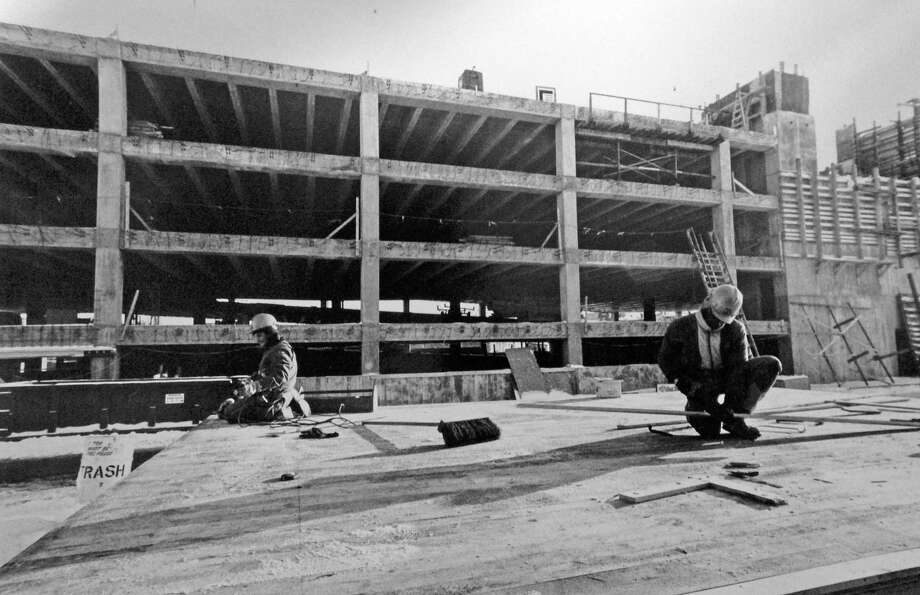
Garage construction - 1983
MAY 1983:    Construction begins on the Stamford Transportation Center, featuring a new train station and parking garage. But construction is halted when cracks are found in beams. Repairs are made and work continues.

AUGUST 2006:       Crumbing concrete, exposed and rusting rebar convince engineers the garage is near the end of its life.   CDOT decides it will be cheaper to demolish the old 727-space parking garage than to repair it… $35 million.

AUGUST 2008:       A hoped-for public-private partnership (PPP) to replace the old garage in its current location and add private office space falls through. 

JULY 2012:   The CDOT tries a PPP again, issuing an RFP (Request for Proposals) for replacement parking within a quarter mile of the station.  Developers are promised confidentiality.  There are no public hearings on any concepts, leaving commuters in the dust. After protests, Governor Malloy appoints a panel to oversee the CDOT process of selecting a developer.  The group meets secretly, never seeking public input nor ever issuing a report on its work.

JULY 1, 2013:         Developer John McClutchy and family donate $30,000 to the CT State Central Democratic Committee.  By February 2015, the McClutchy’s have donated $165,000 to that federal account, bypassing state laws prohibiting contractor contributions to candidates.

John McClutchy
JULY 11 2013:        The CDOT announces its choice of developers for the Stamford Garage, JHM Group of Companies (headed by John McClutchy), which proposes a 600,000 sq ft office / hotel complex on the site of the old garage while parking is moved a quarter mile away.  Negotiations on a final deal get underway.

NOVEMBER 2014:            Having been completely bypassed in the state’s decision making process about the garage project, the City of Stamford Zoning Board passes a new zoning ordinance giving it final approval over any projects near the train station.

MARCH 2015:         In response, the Governor introduces HB-6851, a bill to give the state control of all development within a half mile of any transit station.  The bill would create a quasi-governmental CT Transit Corridor Development Authority, all of its members appointed by the Governor, with the power of eminent domain.  The bill is eventually killed.

APRIL 2015:           Large chunks of concrete fall from the ceiling of the Stamford Garage prompting CDOT to close the facility for safety inspection, displacing 700+ daily parkers.
Spawling concrete, rusted rebar


JULY 2015:             The second anniversary of CDOT’s selection of JHM as developer of the garage passes, but there is still no signed contract.  The old garage remains closed into a third month with no word on repairs.

OCTOBER 2015:     CDOT announces it will spend $1.5 million and six months to repair part of the old garage, eventually re-opening 270 of its 727 spaces.


Those facts speak for themselves.  My only opinion:  if CDOT can so mismanage a small project like this, what’s going to happen when Governor Malloy gives them $100 billion to spend on his 30-year transportation plan?

THE MUSEUM THAT OWNS ITS OWN RAILROAD

Happy 30 th birthday to the largest railroad museum in Connecticut, the Railroad Museum of New England in Thomaston. It was in 1996 that...