June 27, 2010

The Bar Car Debate - Your Turn


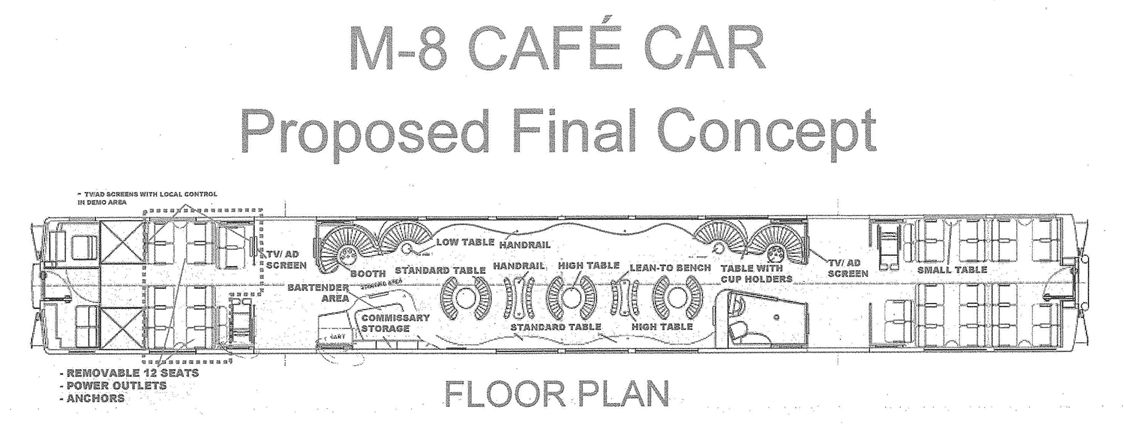
Much has been written about Metro-North’s fabled bar cars, the only such rolling pubs on a commuter railroad in North America. Reports of their demise are wrong, as CDOT is considering adding bar cars to the next M8 car order.

The CT Rail Commuter Council has been given a preliminary design which CDOT is using to seek bids from Kawasaki, so we thought it wise to seek rider input. We’re running an online survey for another few weeks.

As of this writing almost 450 people have chimed in, many of them adding interesting comments, which I share with you this week.

On the “pro” side…

“They (bar cars) give people a real chance to connect after a long day. We all hope they continue.” “…they’re a nice place to unwind and chit chat with other commuters. It makes the commute a bit easier to swallow”. “I have met some of my best friends on these bar cars, as it is a great social environment as well as an opportunity to network with others.”

But on the “con” side…

“I don't see a need for a bar car. The trains are noisy as it is and adding a bar car only makes the commute more stressful for those many commuters that do not use a bar car.” “We need seats on the NH not bar cars. People get out of these bar cars and into their personal vehicles and become hazards to others on the road.” “I prefer to have more seating. Last night's commute home felt like I was in India. We need more seats not bars.” “The bar car is an incredibly stupid idea. They are inefficient and wasteful. A taxpayer-supported railroad should not be running around with bar cars onboard.”

Many respondents commented on the proposed shorter bar, moving the bathroom to the center of the car and new seating patterns.

“This was obviously designed by someone with limited exposure to the practical / functional aspects of the current setup. I would suggest having the designer ride the bar car a few dozen times at peak hour to better define and frame the task at hand.” “We are saying no to bikes for space reasons and we shouldn't give a benefit for drinkers just because it's fun.”

Others suggested power outlets and space for laptops… fold-down or removable seats… and several felt a drawing isn’t enough: “put a mockup at Grand Central so we can better evaluate and give ideas.”

Another idea… “If possible, raise windows so that a standing person can look out the window at a 90 degree angle. As currently configured, an average sized person who is standing only has a view of the ground.”

A branch-line rider asked… “Have there been any considerations to adding a bar car to the Danbury Line?” Sorry, only when (and if) the line is re-electrified. Until then bar cars will only be used on the main line.

Finally, one wishful respondent summed up the thoughts of many with “free beer please.”

To see the proposed bar car design and add your comments to the online survey, visit the CT Rail Commuter Council’s website at www.trainweb.org/ct

June 13, 2010

Saving Money Going to NYC

Whether you’re a daily commuter, an occasional day-tripper or have friends visiting this summer, everyone can save money when you go into NYC by following this time-tested advice:

TRANSITCHEK: See if your employer subscribes to this fabulous service, which allows workers to buy up to $230 per month in transit using pre-tax dollars. If you’re in the upper tax brackets, that’s a huge savings on commutation. A recent survey shows that 45% of all New York City companies offer TransitChek which can be used on trains, subways and even ferries. But Congress needs to act soon to continue this benefit, so if you’re one of the employees, write your lawmaker!

GO OFF-PEAK: If you can arrive at Grand Central weekdays after 10 am and avoid the 4 pm – 8 pm peak return hours, you can save 15 – 20%. Off-peak’s also in effect on weekends and holidays. Your train will be less crowded, too.

BUY TICKETS IN ADVANCE: Buy your ticket on the train and you’ll pay the conductor a $5.75 - $6.50 “service charge”… a mistake you’ll make only once! There are ticket machines at most stations, but the cheapest tickets are those bought online. And go for the ten-trip tickets to save an additional 15%. They can be shared among passengers and are good for a year.

KIDS, FAMILY & SENIOR FARES: Buy tickets for your kids (ages 5 – 11) in advance and save 50% over adult fares. Or pay $1 per kid on board (up to four kids traveling with an adult, but not in morning peak hours). Seniors, the disabled and those on Medicare get 50% off the one way peak fare. But you must have proper ID and you can’t go in the morning rush hours.

FREE STATION PARKING: Even stations that require parking permits usually offer free parking after 5 pm, on nights and weekends. Check with your local town.

CHEAPER STATION PARKING: Don’t waste money parking at comparatively “expensive” station garages like South Norwalk ($ 6.50 per day M-F, $4.75 on weekends) or Stamford ($8 for 8 hours, M-F). Instead, park at the day-lots in Darien or Noroton Heights for just $3. But be sure to buy a scratch-off ticket in advance.

Once you’re in the city, you can save even more money.

AVOID CABS: I have nothing against taxis, but they’re getting mighty expensive: $2.50 when you enter the cab, $0.40 for each minute or one-fifth of a mile. Add on a $1 surcharge from 4 – 8 pm weekdays, $0.50 after 8 pm and a state mandated $0.50 per ride anytime, not to mention a tip… and it all adds up. Instead, take the bus or subway. Or try walking.

USE METROCARDS: Forget about the old subway tokens. These nifty cards can be bought at most stations (even combined with your Metro-North ticket) and offer some incredible deals: put $8 on a card (bought with cash, credit or debit card) and you get a 15% bonus. Swipe your card to ride the subway and you’ll get a free transfer to a connecting bus. You can buy unlimited ride MetroCards for a single day ($8.25), a week ($27), 14 days ($51.50) or a month ($89). There’s now even an ExpressPay MetroCard the refills itself like an EZ-Pass.

CHEAPER TO DRIVE?: Despite being a mass transit advocate, there may be times when it’s truly cheaper to drive to Manhattan than take the train, especially with three or more passengers. You probably know how to avoid bridge tolls by taking the Major Deegan to the Willis / Third Ave. bridge, but I can’t help you with the traffic you’ll have to endure. But do check out www.bestparking.com to find a great list of parking lots and their rates close to your destination. Or drive to Shea Stadium and take the subway from there.

The bottom line is that it ain’t cheap going into “the city”. But with a little planning and some insider tips, you can still save money. Enjoy!

June 04, 2010

Are Ferries In Our Future?

If you believe in ferries, then clap your hands. Sage advice from Peter Pan. But as your applause subsides, let me debunk the popular myth that the solutions to our transportation woes can be found on Long Island Sound. Ferry boats face several challenges:

SPEED: In open water, fast ferries on the Sound could make 30 knots (35 mph). But if they must sail up inlets to the downtown areas of Bridgeport, Norwalk or Stamford, that speed is cut to 5 knots, losing precious travel time.

DOCKING: To keep to competitive speeds, docks would have to be located close to the Sound. That’s expensive real estate. And what about parking at those docks… and travel time on local roads to reach them? Again, more lost travel time.

FREQUENCY: Metro-North offers trains to midtown New York every 20 minutes in rush hour. No ferry service anywhere in the country can compete with that frequency of service. Will travelers really be willing to wait an hour or two for the next boat?

COMFORT: In nice weather, a boat ride to work sounds idyllic. But what about in a blizzard? The bumpiest ride on the train pales by comparison.
FARES: The most optimistic of would-be ferry operators estimate their fares will be at least double those charged on the train. And people say Metro-North is too expensive?

OPERATING COSTS: One of the reasons fares would be so high is that fast ferries are gas guzzlers, the aquatic equivalent to the Concorde. When the Pequot Indians built high speed catamarans to ferry gamblers to their casino in Connecticut to lose money, the service cost so much that the Pequot’s dry-docked the ship in New London.

COMPETITION: When a private operator tried to run ferry service from Glen Cove Long Island to midtown, paralleling a route well served by the LIRR, they shut down after just a few months because they couldn’t compete with the trains. Coastal Connecticut is already well-served by fast, efficient rail service, so why duplicate what already works?

A proposed ferry from Atlantic Highlands NJ stopping in Norwalk enroute to Martha’s Vineyard might be a viable alternative to crush-hour on I-95. But they’re talking about one-way fares of $200 per person. My biggest chuckle about the plan came when a Norwalk city official suggested islanders might use it to visit Norwalk for a vacation. Oh, really?

The final reason I don’t think ferries make economic sense is that nobody else does. Ferry operators (like the near-bankrupt NY Waterways) aren’t stupid. They’ve looked at possible service from coastal Connecticut, crunched the numbers and backed off. In a free market economy, if a buck could be made running ferries, they’d be operating by now. They aren’t, and there are lots of reasons why, many of which I’ve listed.

The only place ferries are running successfully is where they’re heavily subsidized (everywhere), have a monopoly (for example, getting to downtown Seattle from an island suburb), don’t duplicate existing transportation routes (like from Bridgeport to Port Jefferson), or offer advantages of speed because they operate on extremely short runs (from Hoboken to midtown). Our situation here in Connecticut matches none of those tests.

You already know I’m a train nut. (The bumper sticker on my car reads “I’d Rather Be On The Train.”). And I do love an occasional recreational sail on the Sound. But I just think it’s unrealistic to think that commutation by ferries is realistically in our future.

Sorry Tinkerbelle. I’m not clapping.

May 16, 2010

More Secrets of Grand Central

There is possibly no more beautiful railroad station in the world than New York City’s Grand Central Terminal. (Note: It’s a ‘terminal’ not a station, because there are no ‘through-trains’).

As the destination of over 55,000 daily commuters from Connecticut, it’s a place where we spend a fair amount of time. But rather than rush to or from your train, next time you’re in GCT, look around and enjoy some of its hidden secrets.

Based on 40+ years of commuting experience, here are some of the nooks and crannies within the station that I find most fascinating… and useful.

The Million Dollar Clock: The famous clock atop the information booth in the main concourse looks good for a reason. Its four faces are made from opal, valued in excess of $10 million.

Look Up: Most people know about the zodiac ceiling painting in the main hall. But did you know the night sky is actually reversed? Or that, in its cleaning of soot and cigarette smoke years ago, one small rectangle was left in its darkened form? Just look in the northwest corner of the ceiling.

Underground Access:
Sure, you can enter Grand Central from street level, but in bad weather you can find your way underground from blocks away. The new north-end access afforded at Madison and 47th St., Park Ave. and 48th Street, and the Helmsley Building at Park and 45th Street walk-ways are dandy. But did you know you can also access from 43rd or 45th Street, west of Vanderbilt, or via the subway’s shuttle station, on the south side of 42nd Street, just west of Park? There’s also a tunnel under Lexington Avenue directly from the Chrysler Building.

Fastest Way from the Lower Level: Many trains from Connecticut dump you on the lower level. But forget about the ramps or stairs for the long climb to street level. Instead, walk to the forward end of the train and look for the elevator near Track 112. It will take you to the upper level or, better yet, punch “E” and you’ll emerge within steps of Vanderbilt Avenue (see below).

Washrooms with No Wait: The new washrooms at the west end of the lower level have helped a lot, but still there’s often a line. Take the nearby escalator up one level, go right and just before the ramp up to 42nd St. and Vanderbilt, look on your left for the sign for the Oyster Bar. Go down the steps into the bar and you’ll find ornate bathrooms known only to a few, and staffed by a full-time attendant.

Best Place to Get a Cab: Forget about the long line at the taxi stand on 42nd St east of Vanderbilt. Instead, go out the west end of the Main Concourse, up the stairs, and out onto Vanderbilt Avenue. Cross the street and wait at the corner of 43rd Street. Taxis flow through here, leaving off passengers every few seconds. If you are heading west you’ll also avoid the heavy traffic on 42nd Street.

Recycling but Not Re-Reading: When newspaper recycling came to Grand Central in the 90’s, it apparently worked too well. Papers tossed into the open bins were too easily retrieved and re-read by others. To curb the loss in sales, the New York Times paid to have the bins capped and recycling increased by a ton of paper a day.

These are a few of my favorite “secrets” of Grand Central. Drop me an e-mail with yours and I’ll include them in a future column.

May 04, 2010

Bar Cars, The NY Times & The Truth

In an earlier life I was a journalist. A pretty good one too, winning awards in my time at NBC News and local stations. We used to have a joke in the newsroom about sloppy reporting, commenting that a reporter “should never let the facts get in the way of a good story.”

That rubric came to mind when I first read the NY Times’ April 20th feature on pending demise of Metro-North’s bar cars. I had spoken with the reporter, Michael Grynbaum, about the story. I even sent him to talk to others involved in the efforts to save the last commuter rail bar cars in the US.

But despite our conversations, he got the story wrong. Very wrong.

As I have written here before, the eight bar cars serving Metro-North riders in Connecticut are vastly popular but often under threat. When ridership peaked before the recession, there was some talk of adding seats to the bar cars, doing away with their 1950’s style banquette seats. Some of the old bar cars were literally being held together with duct tape while other cars of the same era went thru rehab, getting new electronics and cleaned interiors. Clearly, the priority was seats, not in-transit bar service.

But as of today, our sacred bar cars have been rejuvenated, having gone through the railroad’s CSR (Critical Systems Replacement) program. The cars are good for another 15 – 20 years and there are no, repeat NO, plans to remove them from service.

What is at question is whether we will see bar car designs for the new M8 car coming on line later this year. Here is where the NY Times got the facts wrong.
The paper implied that CDOT and Metro-North had no designs for an M8 bar car. Not so. The CT Rail Commuter Council has seen those designs and we’ve been told in recent days they are in the hands of Kawasaki, the M8’s builder, for bids.
Why would the state be seeking bids on an M8 bar car if they were being eliminated?

But remember that old newsroom mantra: “Never let the facts… etc.”

The Times also implied that when the new M8 cars come into service, all of our older cars (including the eight bar cars) would be scrapped. Not so. CDOT and Metro-North have long planned to retain about 150 of the rehab’ed cars, including the bar cars.

So even if there is no M8 bar car (and I have every confidence there will be), we’ll still have the older models. Ipso facto, the NY Times was wrong. But here’s where the fun begins.

Every media outlet in the NY area ran with the Times’ story, none of them even checking with me (as they usually do) to get the facts. If it was in the NY Times, it had to be true! Wow… what a lesson we’ve learned.

The day after the Times’ story came out, I reconfirmed my facts with the CDOT and Metro-North officials at our long-scheduled Commuter Council meeting. The next week was spent playing one-man truth squad, setting the record straight with commuters, lawmakers and media.

I even e-mailed the NY Times asking for an official correction. Surely, I thought, some editor would see the factual errors their reporter had committed and set the record straight. But of the list of factual flaws I cited in the original article, only one was acknowledged in a tiny correction printed April 28th…

“An article last Wednesday about the uncertain future of the bar cars on the Metro-North Railroad referred erroneously to their interiors. They are decorated with wallpaper designed to look like wood paneling; they do not have actual wood paneling.”

That’s the best I could elicit from the NY Times’ editors, perhaps the smallest of the mistakes I showed them. That the other mistakes were not corrected, or even acknowledged, speaks to the sloppy journalism and arrogance of this once great newspaper.

How sad.

April 04, 2010

"Peak Oil and our Future"

You think things are bad now? Just wait.

We could be inches or minutes away from a global economic crisis that will make the current recession look like fun… the day we realize we’re running out of oil.

For decades we’ve lived (and driven) in denial, somehow assuming we have the “right” to cheap gas, and therefore, low-cost transportation. Now it’s time to face reality and consider what will happen when (not if) gas hits $10 a gallon.

The following are my and others’ hypotheses. (Follow the embedded links for recent news coverage that contribute to my theories.) These things haven’t happened… yet:

AIR TRANSPORT: Following the demise of a dozen airlines and the shrinking of the remaining carriers, air fares soar and service is cut. Air travel becomes affordable to few. Airport congestion fades as business trips are replaced with tele-conferencing. Hotels are shuttered as “leisure travel” becomes unaffordable.

HIGHWAYS: Rush-hour in Connecticut on I-95 is a breeze as half of all motorists can no longer afford to drive. But the highways are a mess of potholes as the price of asphalt (made from petroleum) quintuples, making it impossible to maintain the roads because gas tax revenues have dropped with decreased sales. With more people unemployed or working from home or on flex-time, traffic congestion is a thing of the past.

AT HOME: With home heating oil at $12 a gallon, people close off rooms in their McMansions and huddle in the few remaining spaces they can afford to heat, usually with wood stoves, which are also in short supply. Winter’s gloom is augmented by a constant grey haze of wood smoke. Office buildings, by law, can heat to no more than 60 degrees in colder months. Sweaters are the new fashion statement (think Jimmy Carter and cardigans in the 70’s).

MASS TRANSIT: Delivery delays in the long awaited M10 railcars and fears that their manufacturer, General Motors, may declare bankruptcy (again) send rail commutation into a tail-spin. Seats are pulled out of cars to create standing room capacity and Metro-North offers cheaper fares to those who can’t get a seat. As in Tokyo, “pushers” (click here for video) are assigned at Grand Central to squeeze passengers into trains. Few can afford to drive and park at rail stations, so most spaces there are turned over to bike racks. Despite fare increases, ridership soars.

AROUND TOWN: Local street traffic drops as people consolidate their few truly necessary shopping trips. Because food is so dependent on pricey oil (used for fertilizers, packaging and transport), food prices soar. Food imported out of season becomes a rare treat. Few can afford to eat out at now-chilly restaurants dealing with the same food shortages. Wagons and carts, bikes with racks, mopeds and scooters replace the SUV. Kids take the school bus daily instead of being chauffeured by Mom. Suburban housing prices continue to fall as people flock to the walkable cities with good mass transit. Towns taxes rise, encouraging further migration. Schools can’t afford good teachers who must still commute from far away due to lack of local affordable housing.

THE ENVIRONMENT: Oil drilling, begun recently off the East and West coasts, doesn’t help as supplies of crude will not reach refineries for three more years. In a panic, Congress weakens clean air laws to permit increased use of coal in power plants. Air pollution worsens and acid rain decimates much of the Northeast. Increased CO2 emissions hasten global warming. The sea level rises and coastal communities risk greater flooding as more numerous and powerful hurricanes ravage the US.

THE ECONOMY: The recession becomes a Depression as the impact of decreased mobility and soaring energy costs hit home. China decides to stop buying US Treasury notes and the US dollar hits new lows, making imported oil even more expensive.

Will any of these predictions come true? Time will tell. What can we do to prevent this Doomsday scenario? Not much.

So enjoy what’s left of the era of cheap oil. We’ll all have a lot of explaining to do to our grandchildren.

(For more, see www.lifeaftertheoilcrash.net and www.oilcrashmovie.com or just Google “peak oil”.)

March 21, 2010

Ye Olde Commute

When the big storm hit last week, like many in my town, I was left in the cold and dark for several days. The Darien Library became my second home, affording me a chance finally to read historian Kenneth Reiss’s “The Story of Darien Connecticut”, an excellent new book.

What I found was that the story of this “bedroom” community’s growth was intimately linked to transportation.

As early as 1699 roads had been laid out on routes still used today. But where today those roads are lined with trees (whose felling by the storm left us without power or passage!), by the mid-1700’s most of southern Fairfield county had been cleared of all trees to allow for farming. Those mighty oaks taken out by the storm were not as old as we’d thought.

In the 1770’s the maintenance of Country Road (now known as Old Kings Highway) was the responsibility of the locals. Every able bodied man and beast could be enlisted for two days each year to keep the roads in good shape. But traffic then consisted mostly of farm carts, horses and pedestrians.

By 1785 there was only one privately owned “pleasure” vehicle in all of Stamford, a two-wheeled chaise owned by the affluent John Davenport.

At the end of the 18th century it was clear that we needed more roads and the state authorized more than a hundred privately-funded toll roads to be built. The deal was that, after building the road and charging tolls, once investors had recouped their costs plus 12% annual interest, the roads were revert to state control. Of the 121 toll-road franchises authorized by the legislature, not one met that goal.

One of the first such roads was the original Connecticut Turnpike, now Route 1, the Boston Post Road. Another was the Norwalk to Danbury ‘pike, now Route 7.

Four toll gates were erected: Greenwich, Stamford, the Saugatuck River Bridge and Fairfield. No tolls were collected for those going to church, militia muster or farmers going to the mills. Everyone else paid 15 cents at each toll barrier.
The locals quickly found roads to bypass the tolls which were nicknamed “shun-pikes”.

Regular horse-drawn coaches carried passengers from Boston to NY. And three days a week there was a coach from Darien to Stamford, connecting to a steamboat to New York.

The last tolls were collected in 1854, shortly after the New York & New Haven Railroad started service. An 1850 timetable showed three trains a day from Darien to NYC, each averaging two hours and ten minutes. Today Metro-North makes the run in just under an hour.

The one way fare was 70 cents vs today’s $12.25 at rush hour.

By the 1870’s Darien was seeing what we today call “transit oriented development”, as full page ads lured city dwellers to newly built homes near the Noroton station which opened in the 1870’s.

In the 1890’s the one-track railroad was replaced with four tracks, above grade and eliminating street crossings.

In the 1890’s the trolleys arrived. The Stamford Street Railroad ran up the Post Road connecting in downtown Darien with the Norwalk Tramway (rattling along Railroad Ave., now known as Tokeneke Rd.); the latter also offered open-air excursion cars to the Roton Point amusement park in the summer.

Riders could catch a trolley every 40 minutes for a nickel a ride. There were so many trolley lines in the state that it was said you could go all the way from New York to Boston, connecting from line to line, for just five cents a ride.
The trolleys were replaced by buses in 1933.

Fast forward to the present where we are again debating tolls on our roads, possible trolley service in Stamford and T.O.D. (“transit oriented development”) is all the rage. Have things really changed that much over two hundred years?

THE MUSEUM THAT OWNS ITS OWN RAILROAD

Happy 30 th birthday to the largest railroad museum in Connecticut, the Railroad Museum of New England in Thomaston. It was in 1996 that...