December 13, 2010

Thank You Governor Rell

Anyone who follows this column knows I’m bipartisan in my criticism.  Whoever is in power, Democrat or Republican, I’ve got “suggestions” on how they could improve our transportation mess.
Since she came to office in the midst of a scandal, no other politician has been the target of my commentary more often than Governor M. Jodi Rell.  Today, however, I want to give her the credit she’s due for all she’s done on the transportation front.
Watching the Governor ride the first of the new M8 rail cars this week, I was struck by how she had come full circle in only six years.  The irony is it took her entire tenure in office to order, design, build, test and finally deliver these new cars.
In Governor Rell’s first budget address to lawmakers in February 2005 she started to undo years of her predecessors’ neglect of our trains.  She told lawmakers we must order 300 new rail cars, and they did.  Mind you, she told us then the cars would be in service by 2008.  I predicted, accurately it turned out, that 2010 was a better guess.
The Governor said riders should pay a small part of their cost with a modest fare hike, and that too was passed by lawmakers.
But Governor Rell also said that commuters shouldn’t pay more until they were actually riding in the new cars… a promise she kept.  As manufacturing delays by Kawasaki slowed delivery of the M8’s, that planned 1.25% fare hike was deferred.   A politician who keeps a promise.  Imagine that.
More recently, Governor Rell also told the New York MTA, parent of Metro-North, there was no way she was going to raise fares in Connecticut to pay for the budget problems of New York’s own making.  That was a first in the troubled history of Connecticut / New York relations, but again the Governor deserves credit for doing the right thing.
But not every dream came true during the Rell administration. 
Grumblings about a lack of a voting seat on the MTA or Metro-North boards never amounted to more than that… grumbling.
And yes, Governor Rell did change Commissioners in the Dept. of Transportation at a pace that left many people wondering who was in charge:  five Commissioners in six years.  One was a former State Trooper, another had run Bradley airport.  The two most recent of them actually had experience in rail transportation.
Wracked by scandals, Governor Rell was embarrassed on several occasions by her DOT, eventually asking local businessman Michael Critelli to study the agency and issue recommendations for reform.  Of course, few of the group’s suggestions were ever embraced.
Long promised repairs to our dilapidated train stations took four years to happen, thanks mainly to Federal stimulus money.  If this work wasn’t “shovel ready”, nothing was.
We’re still not certain if the much-needed New Haven Rail facility will ever be fully built, as its price yo-yoed from $300 million in 2005 to $1.2 billion in 2008.  The Governor’s solution… pay consultants $630,000 for an audit.  Their report found only $11 million in potential cuts.
Still, Governor Rell was a big rail fan, realizing the importance not only of fixing Metro-North, but planning for the future.  Together with fellow lame-duck Senator Chris Dodd, she secured a serious down-payment on high-speed rail between New Haven and Springfield.  Well, maybe not true “high-speed”, but certainly higher speed than Amtrak currently offers.
I’m not sure how Governor-elect Malloy will do on transportation, though he clearly understands the problems from his years as mayor of Stamford.  His dreams for better mass transit will be most tempered by our economic crisis.

But to outgoing Governor Rell all commuters should give a loud “thank you” for all that she accomplished.  She’ll be a hard act to follow.

October 31, 2010

Trolleys: Riding Back in Time

What was commuting like back in the “good old days”? Well, cheaper, slower and with fewer options. Still, we have nostalgia for our grandparents’ travel methods long before families owned cars. Back then, it was all about trolleys!


It’s been 200 years since trolleys first plied city streets. Initially pulled by horses they were eventually electrified, adding speed and dependability. While we think of streetcars mostly for in-city service, trolleys criss-crossed our state, supplementing the railroads for longer distance travel.


It is true that you could travel all the way from New York to Boston by connecting trolley lines, a nickel a ride. (Click here for a fabulous 1916 timetable showing four routes from NY to Boston complete with descriptions of the towns).


The trolley companies were often owned by power utilities, giving themselves a steady client for their electricity. To generate even more weekend business, trolley lines would often run to amusement parks which they also owned, like Roton Point in Norwalk.


The expansion of the trolley lines had a profound effect on housing, allowing city dwellers to live further than walking distance from their factories. Nowhere was this better illustrated than in Boston as detailed in “Streetcar Suburbs”, a classic sociology text. This was truly the first “Transit Oriented Development”.


But the story of New England’s trolleys is not limited to the history books. Fortunately, we are blessed with two excellent trolley museums just a short drive away.


The Shoreline Trolley Museum in East Haven was founded in 1945 and now boasts more than one hundred trolley cars in its collection. It still runs excursion trolleys for a short run on tracks once used by The Connecticut Company for its “F Line” from New Haven to Branford. You can walk thru the car barns and watch volunteers painstakingly restoring the old cars. There’s also a small museum exhibit and gift shop.


The Connecticut Trolley Museum in East Windsor began in 1940, making it the oldest trolley museum in the US. It too was started on an existing right-of-way, the Rockville branch of the Hartford & Springfield Street Railway Company. You can ride a couple of different trolleys a few miles into the woods and back, perhaps disembarking to tour the collection of streetcars, elevated and inter-urbans in the museum’s sheds and barns.


Both museums also offer you the chance to “drive” a streetcar… under supervision and after a little training. Passengers are not allowed, but your friends can join you if they are brave. If you’re looking for a day-trip, especially for kids, I can highly recommend either museum. But check ahead for hours, especially off-season.


Being born and raised in Toronto, streetcars were always a part of my life. Long before Toronto had a subway or commuter rail service, citizens would go shopping, go to church or an evening at the movies by streetcar. Even today that city of 2.5 million is served by new, Canadian-built streetcars. You can still ride trolleys, both old and new, in New Orleans, Philadelphia, Boston and Newark NJ. There’s even talk of returning streetcars to Stamford.


When it comes to getting around by means other than the auto, everything old is new again.

CT Trolley Museum

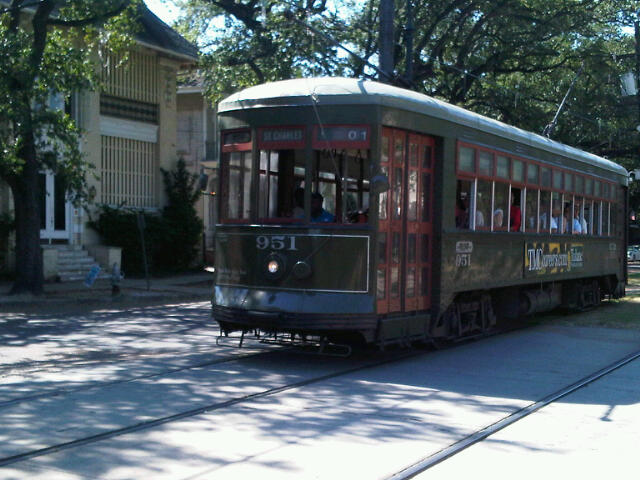
New Orleans trolley on St Charles Ave

PCC Car - CT Trolley Museum

October 03, 2010

A Victory for Commuters

Who says you can’t fight City Hall… or Metro-North?

Back in August I wrote in this column about Metro-North’s latest proposals to gouge commuters. Today I can report they have been soundly defeated.

To close its $800 million budget deficit, the MTA (Metro-North’s parent), has in past months come forward with a series of fare hikes and service cuts, all of them soundly rejected by Governor Rell. Because, although that NY State agency has never heeded our Governor’s requests for a voting seat on its board, Connecticut does have veto power over fare hikes in our state.

I’ve got to hand it to Governor Rell. She’s kept her word since February of 2005 when, in her first budget address, she told the legislature we were long overdue in ordering new rail cars and promised no fare hikes until the cars arrived and went into service. She’s also funneled millions in stimulus funds into fixing up our rail stations.

But this time the MTA was proposing something different… what I called a “stealth” fare hike.

The rail agency proposed cutting the discount on monthly “Mail & Ride” tickets as well as rail tickets bought on the web. They also wanted to reduce the validity of ten-trip tickets from one year to 90 days. And single trip tickets, now valid for six months, would expire in a week.

What were they thinking? Short of having conductors spit at passengers, these changes were almost like yelling “screw you” to their customers?

Once again, the CT Rail Commuter Council had its work to do. First, in publicizing the proposal through the media. Then, in demanding public hearings (though none were originally planned in Connecticut). And finally, in rallying commuters to attend and speak out against these proposals.

For the record, I should note that the Council has, in the past, supported small fare hikes… when they were tied to the cost of living and matched against improvements in service. But these proposals were neither.

The MTA’s budget deficit is of its own creation, not Connecticut’s. So New York taxpayers and commuters should pay for it, not us. Connecticut has never been asked for input on the multi-billion dollar mega-projects undertaken by the MTA, like the $6 billion to build tunnels bringing the Long Island Railroad into Grand Central, so why stick us with the bill?

Isn’t reducing a discount equivalent to a fare increase? You betcha!

And what possible reason could Metro-North offer for shortening the validity of ten-trip tickets? Incredibly, they said it was to deal with the “problem of uncollected tickets.”

Amazing. For about a decade the Commuter Council has been beating on Metro-North about conductors not doing their jobs, leaving tickets uncollected on crowded trains. By its own calculations, Metro-North loses $2 million a year on uncollected tickets. And their solution is to screw customers by selling them ten-trips but letting them only use two or three rides, then declare their ticket invalid?

And the icing on the cake, the final proposal from the MTA? A $15 fee to cash in an unexpired ticket!

The Commuter Council was curious just how much money would be raised if these plans were approved, so we filed a formal written request for that data. The answer: about a half-million dollars a year in Connecticut. That’s nothing… a rounding error… bupkis! An $800 million budget deficit, and all these proposed changes will bring in $500,000?

Governor Rell heard our argument and agreed. She quickly ordered the CDOT to reject the MTA / Metro-North proposal, a directive read aloud at the public hearings in Stamford and New Haven.

Commuters have won… for now.

September 20, 2010

Keeping the Old Car Running


My constant harangue against traffic and in favor of trains aside, I do own a car: a used ’97 Honda Accord with 130,000 miles on it. It’s a great car (the interior infused with cigar smoke notwithstanding), and I hope to run it into the ground.

Used cars are hot these days. Prices have climbed 10% in a year as more drivers decide to hold onto their cars longer. And why not?

We don’t have to be suckers to Detroit’s game of staking our egos on each year’s new model, which immediately loses 20% of its value the day we drive it home. Used cars can prove perfectly reliable, if you keep them in good shape.

So when I saw a TV infomercial for CarMD, a device that promised a simple way to keep my jalopy going, I was jazzed. I love car tech and this sounded great!

Rather than popping the $99 for the gizmo myself, I suggested to the Darien Library that they purchase one. Yes, I am truly blessed to live in a town with a tech-savvy library that offers patrons any number of gizmos on loan… GPS devices, digital cameras and Kill-A-Watt readers. But now I’m feeling a bit guilty.

Here’s how Car MD is supposed to work.

You take the remote unit, about the size of a fat TV remote, and plug it into your car’s computer output. There’s the first challenge: finding that plug. But the www.carmd.com website has a simple guide by make and model. My plug was behind the ashtray of my ’97 Honda Accord. In my wife’s ’96 Volvo, it was under the coin holder.

Once you’ve turned on and plugged in the CarMD gizmo, you turn on the ignition but you do NOT start the car. The handheld device talks to your car’s computer, downloads the information, beeps four times and you’re done. Well, sort of.

If the handheld device shows a green light (as on my trusty Honda), you’re OK. Your car’s computer has found no problems. But if it’s a yellow light, as I saw on the Volvo, the fun begins.

Next you have to copy down your car’s VIN (vehicle identification number). Good luck reading that, if you can find it.

You then load the CarMD software onto your computer, register online with name and address (no, I did not read their Privacy Policy!) and open the software. Type in the VIN and the system should identify your car by year, make and model. You can register three cars per device and they don’t all have to belong to you.

But here’s where I was disappointed. When I clicked the “check health status” button, the software displayed umpteen TSB’s (Technical Service Bulletins) for the Volvo going back to 1992 (even though the car is a ’96) but to read the full details it’s $1.99 per report or $19.95 a year to read them all.

Worse yet, the software told me nothing about why the yellow light was showing on the handheld device. A call to CarMD’s Customer Service (friendly and knowledgeable) got to the root of the problem: the Volvo’s “check engine” light wasn’t on.

In other words, unless your car’s computer has already found a problem and turned on that ominous dashboard display, CarMD isn’t going to tell you much of anything. But it will ask you for money.

CarMD is nothing but a big thumb drive, no smarter than your car’s computer.

Now, had my check engine light been on, Car MD would, in theory, have told me what’s wrong with the car and given me an estimate of how much it would cost to fix it: valuable info to arm myself with before heading to the service station.

But until the “check engine” light shows up on your dashboard, save your money. CarMD isn’t going to do more than frustrate you. Save your dough… maybe to buy a new used car.

September 06, 2010

"Why Hartford Hates The Gold Coast"

I was watching CT-N the other night (my favorite reality TV channel) as the members of the CPTC (Citizens Public Transportation Commission) were meeting for an incredibly boring discussion the state’s transit woes. But toward the end of the meeting, my ears perked up as one of the 80+ year old members started on a rant.

“Our next Governor is going to be ‘gold plated,’” he said. “He’ll come from Fairfield County, the Gold Coast, so heaven help us!”

Not even the lone member of the Commission from Fairfield County dared challenge this crazy assumption that a Governor from the ultra-affluent downstate region would do anything but spend to help Fairfield County while ignoring the rest of the state.

Which got me thinking: Why does everyone upstate mistrust us, we who live on the Gold Coast?

Years ago, when I used to journey to Hartford for my annual appeal to the legislature’s Transportation Committee to invest in new rail cars for Metro-North, I could feel and hear the resentment. Then-Committee Chairman, Senator Billy Ciotto ( D – Wethersfield) would excoriate my testimony, once saying “You people on the Gold Coast can buy your own damn trains!”

Even the CT Rail Commuter Council’s long-time member from Guilford (Shore Line East territory), an otherwise learned and reasonable man, says that Fairfield County isn’t the “real Connecticut.” Oh, really?

Consider the facts:

WE PAY THE TAXES: Forty-plus percent of all the taxes collected in this state come from Fairfield County. Something like 15% of the state’s total collections come from Greenwich, New Canaan and Darien alone. Without Fairfield County taxes, upstate residents’ tax rates would soar.

BUT WE DON’T GET THE BENEFITS: Though we pay most of the taxes, we get almost nothing back in return. Towns like Darien get back 1 cent for every dollar sent to Hartford. One cent! Who’s gold plating the roads in Wethersfield? We are.

WE’RE NOT ALL MILLIONAIRES: Sure, there are some affluent families living along the Gold Coast? But our state’s most populous and poorest city, Bridgeport, is here too. I’d guess there are far more people living in poverty in Norwalk, Stamford and Greenwich than in West Hartford or Farmington.

WE’RE THE VICTIMS OF TRANSIT NEGLECT: Who suffers more from traffic congestion than those who drive I-95 through Fairfield County? And who pays the highest commuter rail fares in the US, but Metro-North riders? Our rail cars are older than most passengers and our highways show the scars of decades of neglect.

So for those people who live north of the Merritt Parkway (the Mason – Dixon line of state politics), get over yourselves and stop portraying us as free-spending fat cats living not in Connecticut but some annex of New York City.

Connecticut’s next Governor will come from Fairfield County. And that’s a good thing. Who knows more about what happens when you don’t invest in your highways and trains?

Maybe the shiny new commuter rail from New Haven to Springfield (which we’ll all be heavily subsidizing) can learn from Metro-North’s mistakes. Maybe a new Governor can extend Shore Line East from Old Saybrook beyond New London to Mystic, Stonington and even Rhode Island, turning local rail critics into passengers.

To her credit, Brookfield’s Jodi Rell has served our entire state’s interests as Governor, especially in funding improved mass transit state-wide, not just in her own home town. And I have every confidence that Dan Malloy or Tom Foley will be Governor of all of Connecticut, upstate and down, from the Quiet Corner to, yes, even the Gold Coast.

August 22, 2010

Five Years After Katrina - What Have We Learned?

We were all awe-struck five years ago watching the coverage of the rescue efforts in the Gulf following hurricane Katrina. But did we learn anything from that tragedy?
Remember: our annual hurricane season is well underway and storm activity peaks around this time each year. And we ready for “the big one”?

Consider the following:

1) Transportation Means Survival: The difference between those who lived and died in New Orleans was based on access to transportation. When told to evacuate, those with cars did. Those without couldn’t and were stranded. The lack of public transportation along the Gulf Coast left the “disadvantaged” as just that… dis-advantaged, and maybe dead.

How would those living along the Connecticut coast be evacuated if a category four hurricane were threatening us? Join the crawl on I-95? Take Metro-North? Or hunker down at a local mall. How many of our towns have adequate shelter or emergency supplies?

Is Amtrak ready, along with Metro-North, to deploy its fleet to evacuate the hundreds of thousands threatened by a hurricane? Doubtful.

2) Our Classless Society Isn’t: The victims of Katrina weren’t characterized as much by race as by economic class. Being able to afford to live away from the flood plain and have access to private transportation both cost money. This isn’t about race: you don’t have to be Black to be poor.

But after Katrina, then-President Bush’s mother, Barbara, was touring the Katrina refugee camps in Houston. She commented that, given the squalor of their former New Orleans homes, these victims of Katrina were actually better off than before. Then she added “it’s kind of scary that they might all want to stay in Texas.”

Where would Connecticut’s refugees flee after an evacuation? And how long would they be gone pending recovery and rebuilding? Gold Coasters perhaps could drive their SUV’s up to familiar ski country in New England. But where would the Hispanic, Haitian and Black populations of Stamford, Norwalk and Bridgeport go… and would they also be made to feel like so many dust bowl Oakies when they arrived at refugee camps?

3) Our Government Is Incompetent: Katrina and 9/11 showed us that our government can’t do a damn thing to protect its citizens. One might excuse a surprise terrorist attack, but a long anticipated, well-scenarioed hurricane? Not a chance.

At the time of Katrina, 75 percent of FEMA’s budget was being spent on anti-terrorism efforts, even though acts of nature present the real danger to most Americans. Gobbled up into the Homeland Security Agency, FEMA had lost all clout, competence and most of its budget. “Brownie” may have been doing a “helluva job”, but would his successor do any better five years on?

Ask any old-timer about the Hurricane of 1938 which devastated New England that September. It still ranks as the worst natural disaster to ever hit our state. True, the human toll was compounded because we had no notice of the coming storm. But even with sufficient time to evacuate, a storm of that size would devastate this state, especially our most expensive homes built along the coast.

Santayana said: “Those who cannot learn from history are doomed to repeat it.” Have we really learned the lessons of Katrina?

August 16, 2010

We're Mad As Hell...

Sometimes we commuters feel like Howard Beale from the 1976 movie “Network”. We’re as mad as hell and we’re not going to take it anymore!

The MTA, parent of Metro-North, is at it again. Under the guise of balancing their budget, they’re proposing rules changes that will penalize riders, hike fares and discourage ridership. For the moment, these proposals will not affect riders in Connecticut, where fares are set by our DOT. But the pressures for increased revenue may yet hit riders in the Nutmeg State.

The most expensive commuter railroad in the US is about to get a lot more expensive. Here’s what the MTA is proposing:

PARKING INCREASES: The MTA controls parking at two dozen NY stations and is calling for a 14.5% price hike, which will translate into an additional $840,000 in revenue to the railroad.

FARE HIKES: Coming on the heels of fare hikes earlier this year, the MTA wants to jump fares another 7.5% – 9.4%

TICKET RULES: Ten-trip tickets, which used to be valid for a year, will only be good for 90 days. And single fare tickets, previously good for 90 days, will expire after a month.

PEAK & OFF-PEAK:
There’s even discussion about eliminating, or at least reducing, the 15% – 20% discount for off-peak fares. This would really hurt Metro-North riders, nearly three-quarters of whom ride on off-peak fares.

WEB TICKETS: The cheapest way to buy any ticket on Metro-North is via the web. But the 2% discount for online sales may also be eliminated.

TICKET REFUNDS: Did you find an unused, valid ticket in your desk and want to “cash it in”? The railroad will hit you with a service charge.

METRO-CARD: Want a new Metro-Card instead of refilling an old one? That will cost you a buck. The popular unlimited-rides monthly card, now $89, would be limited to 90 rides for $99. Or you can pay $105 for the unlimited version.

EZ PASS: Tolls on MTA-controlled bridges (like the Whitestone, Throgs Neck and Henry Hudson) would increase 10%.

JOBS / SALARIES: Two hundred ticket clerk jobs in the subway have already been eliminated. The MTA is proposing a freeze on transit workers’ salaries after two 4% pay hikes in as many years.

One person not losing his job and apparently unwilling to cut his pay is MTA Chairman Jay Walder who earns $350,000 and just purchased a three bedroom condo on Manhattan’s upper West Side for $1.6 million.

All of these price hikes are aimed at closing the MTA’s $800 million budget deficit, which was created by cuts in NY state subsidies plus debt service on billions in bonding for massive capital projects like bringing the LIRR into Grand Central and building the Second Avenue subway.

But hey! Let’s not just get mad as hell… let’s think of some alternatives!

DISTANCE BASED FARES: Why is the fare on the NYC subway the same whether you take the shuttle to Times Square or ride the A train from northern Manhattan 31 miles to Far Rockaway? Most modern subway lines charge based on distance, just as commuter rail does. This would mean updating the turnstiles, but just out of fairness, shouldn’t subway riders pay more for a longer ride?

WRAPPING THE CARS: Ride any mass-transit system in Europe and you’ll see cars wrapped in advertising. Experiments with exterior ad-wraps on the Times Sq – Grand Central shuttle haven’t hurt ridership but did bring in badly needed revenue. I’d imagine any number of “Mad Men” would pay dearly to wrap their ads around our new M8 cars. And Amtrak has already shown it works with Acela.

Shame on the MTA for sticking it to the commuters! These rules changes will just discourage ridership, not increase income. And decreased ridership just leads to more money problems.

Yes, we’re as mad as hell. And we don’t have to take it anymore! This is an election year. Let’s create a commuter voting block and make sure the candidates pay more than lip-service to really supporting mass transit.

THE MUSEUM THAT OWNS ITS OWN RAILROAD

Happy 30 th birthday to the largest railroad museum in Connecticut, the Railroad Museum of New England in Thomaston. It was in 1996 that...