We all know what happened when Boston decided to bury its downtown elevated interstate highway, known as the central artery. What was intended to be a seven year, $2.5 billion project became a ten year, $14.6 billion engineering nightmare.
Well, heads up fellow commuters and taxpayers! The MTA has similar designs on our beloved Grand Central. Nicknamed the “East Side Access” project, the goal is to bring the Long Island Railroad into Grand Central.
The plan would see use of the lower level of the 63rd Street subway tunnel, allowing some LIRR trains from Queens to enter Manhattan and then follow a new, very deep tunnel under existing Metro-North tracks beneath Park Avenue. Trains would terminate fourteen stories under Grand Central on eight tracks with up to 24 trains per hour. Exiting passengers… an estimated 162,000 per day… would be whisked upward on high speed escalators, to the west side of GCT, with an underground concourse complex stretching from 43rd to 48th streets.
Estimated cost for the project… $8 billion… about the same as rebuilding the entire World Trade Center complex. Actual cost, factoring in inevitable delays, cost over-runs and typical under-estimation by politically sensitive designers… who knows, maybe double that? And for what gain?
The only reason for the East Side Access project is to give LIRR riders better access to midtown. Is the subway ride from Penn Station to GCT really all that bad? Imagine what we could do with $8 billion to improve commuter rail service in the tri-state region.
What would an almost doubling of passengers in GCT (by adding LIRR to existing Metro-North riders) mean for Connecticut commuters? Well, if you think the station’s crowded now, you ain’t seen nuthin’ yet. And just imagine the already jam-packed Lexington Avenue subway station with even more riders!
The currently under-utilized GCT would quickly be maxed out for trains and platforms, making much-needed expansion of service to Connecticut a real problem.
True, diverting some LIRR trains into GCT might free-up “slots” in Penn Station for Metro-North trains (which would travel there by way of the Hell Gate bridge), but don’t count on it, what with New Jersey Transit, Amtrak and LIRR also vying for more trains in Penn Station.
And speaking of NJ Transit, their plans for a new tunnel under the Hudson River also dream of extending trackage from Penn Station north to Grand Central as well, adding to the fray. But that’s another story.
If all of this concerns you, don’t get your knickers in a knot. There’s nothing you can do to stop it. The money’s already been appropriated and the project should be finished in 2012.
What role did Connecticut play in this boondoggle? Zero… nada… zilch. The MTA didn’t ask our opinion or seek our approval. Though Connecticut Dept. of Transportation is Metro-North’s biggest customer, we still have no seat, no vote and no say on the MTA Board.
For more info on the East Side Access project, see http://www.mta.nyc.ny.us/capconstr/esas/index.html
----------------------------------------------------------------------------
JIM CAMERON has been a commuter out of Darien for 15 years. He is Vice Chairman of the CT Metro-North / Shore Line East Rail Commuter Council, and a member of the Coastal Corridor TIA and the Darien RTM. You can reach him at jim@camcomm.com or www.trainweb.org/ct . For a full collection of “Talking Transportation” columns, see www.talkingtransportation.blogspot.com
March 26, 2006


March 08, 2006
"Highway Service Areas"
Most of us don’t think twice about the decrepit service areas on I-95 and the Merritt Parkway. Their nasty fast food and over-priced gas are best avoided by knowing locals. But a major study is underway by CDOT to rehabilitate these service and rest areas, and they want your views.
I recently attended a focus group which examined the shortcomings of the 31 facilities, most of them in southwest Connecticut. The complaints I heard echo commuters’ gripes about Metro-North: facilities are too old, the bathrooms are dirty and there’s not enough parking.
And what kind of first impression of our fair state do these 1950’s eyesores (built to double as bomb-shelters) give to tourists, now the fastest growing sector of the state’s economy? Even the NY Thruway seems more inviting.
And what about the truckers who ply our interstates and need to take a break? A 2001 CDOT study showed there are 1,200 truckers who must park roadside at night, even on I-95, because there’s no place else … and do so with the complicity of the State Police.
What’s the impact of these service areas on the towns that “host” them?
Darien, which hosts the two busiest rest areas in the Northeast (and the most profitable McDonald’s franchise in the US!) on I-95, and two smaller service areas on the Merritt Parkway, is a case in point.
Police say the Darien I-95 service areas are the town’s crime hot-spots. When the volunteer EMS unit “Post 53” answers a nighttime call at the service areas, they must have a police escort. Neighbors report prostitution and drug needles along the small fence surrounding the rest area… not to mention the environmental impact of run-off into neighboring streams or the air pollution from idling trucks’ refrigeration units (again made possible because State troopers look the other way).
There’s gotta be a better way. And a few ideas that came out of this CDOT sponsored study might give us all some hope.
Like the idea to use I-95 air rights to build a mall-style service area above the highway with parking on either side. Newly designed service areas would have better food, trained greeters to guide tourists to the local sights, maybe even WiFi access, weather and traffic information. Some even suggested farmers markets and solar-powered plug-ins for parked trucks. Or on the Merritt, where service areas are in the National Register of Historic Places and cannot be changed, how about picnic tables and dog-walks?
There will be public meetings on all these plans in the coming months. But you can review what’s being discussed and chime in with your ideas now at www.ctrestareas.org . While CDOT admits it only has funding for the study and may never implement its suggestions, maybe we should err on the side of optimism and give them a few ideas.
----------------------------------------------------------------------------
JIM CAMERON has been a commuter out of Darien for 15 years. He is Vice Chairman of the CT Metro-North / Shore Line East Rail Commuter Council, and a member of the Coastal Corridor TIA and the Darien RTM. You can reach him at jim@camcomm.com or www.trainweb.org/ct . For a full collection of “Talking Transportation” columns, see www.talkingtransportation.blogspot.com
I recently attended a focus group which examined the shortcomings of the 31 facilities, most of them in southwest Connecticut. The complaints I heard echo commuters’ gripes about Metro-North: facilities are too old, the bathrooms are dirty and there’s not enough parking.
And what kind of first impression of our fair state do these 1950’s eyesores (built to double as bomb-shelters) give to tourists, now the fastest growing sector of the state’s economy? Even the NY Thruway seems more inviting.
And what about the truckers who ply our interstates and need to take a break? A 2001 CDOT study showed there are 1,200 truckers who must park roadside at night, even on I-95, because there’s no place else … and do so with the complicity of the State Police.
What’s the impact of these service areas on the towns that “host” them?
Darien, which hosts the two busiest rest areas in the Northeast (and the most profitable McDonald’s franchise in the US!) on I-95, and two smaller service areas on the Merritt Parkway, is a case in point.
Police say the Darien I-95 service areas are the town’s crime hot-spots. When the volunteer EMS unit “Post 53” answers a nighttime call at the service areas, they must have a police escort. Neighbors report prostitution and drug needles along the small fence surrounding the rest area… not to mention the environmental impact of run-off into neighboring streams or the air pollution from idling trucks’ refrigeration units (again made possible because State troopers look the other way).
There’s gotta be a better way. And a few ideas that came out of this CDOT sponsored study might give us all some hope.
Like the idea to use I-95 air rights to build a mall-style service area above the highway with parking on either side. Newly designed service areas would have better food, trained greeters to guide tourists to the local sights, maybe even WiFi access, weather and traffic information. Some even suggested farmers markets and solar-powered plug-ins for parked trucks. Or on the Merritt, where service areas are in the National Register of Historic Places and cannot be changed, how about picnic tables and dog-walks?
There will be public meetings on all these plans in the coming months. But you can review what’s being discussed and chime in with your ideas now at www.ctrestareas.org . While CDOT admits it only has funding for the study and may never implement its suggestions, maybe we should err on the side of optimism and give them a few ideas.
----------------------------------------------------------------------------
JIM CAMERON has been a commuter out of Darien for 15 years. He is Vice Chairman of the CT Metro-North / Shore Line East Rail Commuter Council, and a member of the Coastal Corridor TIA and the Darien RTM. You can reach him at jim@camcomm.com or www.trainweb.org/ct . For a full collection of “Talking Transportation” columns, see www.talkingtransportation.blogspot.com
February 26, 2006
"The Secrets of Grand Central"
There is possibly no more beautiful railroad station in the world than New York City’s Grand Central Terminal. As the destination of over 50,000 daily commuters from Connecticut, it’s a place we spend a fair amount of time. But rather than rush to or from your train, next time you’re in GCT, look around and enjoy some of its hidden secrets.
Based on 40+ years of commuting experience, here are some of the nooks and crannies within the station that I find most fascinating… and useful.
Underground Access: Sure, you can enter Grand Central from street level, but in bad weather you can find your way underground from blocks away. The new north-end access afforded at Madison and 47th St., Park Ave. and 48th Street and the Helmsley Building walk-ways are dandy. But did you know you can also access from 43rd or 45th Street, west of Vanderbilt, or via the shuttle station, on the south side of 42nd Street, just west of Park?
Fastest Way from the Lower Level: If your train dumps you on the lower level, forget about the ramps or stairs for the long climb to street level. Walk to the forward end of the train and look for the elevator near Track 112. It’ll take you to the upper level or, better yet, to within steps of Vanderbilt Avenue (see below).
Best View of the Main Concourse: Ever notice the elevated glass walkways at the east and west ends of the station? They’re accessible (though public access is discouraged). Just go to the entrance to Michael Jordan’s Steakhouse on the mezzanine and take the elevator up two or three floors. When you get off, go left and through the non-descript door on your left. Walk out and you’ll have a panoramic view of the station from almost roof-level.
Washrooms with No Wait: The new washrooms at the west end of the lower level have helped a lot, but still there’s often a line. Take the nearby escalator up one level, turn around, and on your left is the Stationmaster’s Office complete with a waiting room and lav’s. Or, go right and just before the ramp up to 42nd St. and Vanderbilt, look on your left for the sign for the Oyster Bar. Go down the steps into the bar and you’ll find ornate bathrooms known only to a few.
Best Place To Get A Cab: Forget about the long line at the taxi stand on 42nd St east of Vanderbilt. Instead, go out the west end of the Main Concourse, up the stairs and out onto Vanderbilt Avenue. Cross the street and wait at the corner of 43rd. Taxis flow through here, leaving off passengers every few seconds. Heading west you’ll avoid the traffic on 42nd Street.
These are a few of my favorite “secrets” of Grand Central. Drop me an e-mail with yours and I’ll include them in a future column.
------------------------------------------------------------------------------------
JIM CAMERON has been a commuter out of Darien for 15 years. He is Vice Chairman of the CT Metro-North / Shore Line East Rail Commuter Council, and a member of the Coastal Corridor TIA and the Darien RTM. You can reach him at jim@camcomm.com or www.trainweb.org/ct . For a full collection of “Talking Transportation” columns, see www.talkingtransportation.blogspot.com
Based on 40+ years of commuting experience, here are some of the nooks and crannies within the station that I find most fascinating… and useful.
Underground Access: Sure, you can enter Grand Central from street level, but in bad weather you can find your way underground from blocks away. The new north-end access afforded at Madison and 47th St., Park Ave. and 48th Street and the Helmsley Building walk-ways are dandy. But did you know you can also access from 43rd or 45th Street, west of Vanderbilt, or via the shuttle station, on the south side of 42nd Street, just west of Park?
Fastest Way from the Lower Level: If your train dumps you on the lower level, forget about the ramps or stairs for the long climb to street level. Walk to the forward end of the train and look for the elevator near Track 112. It’ll take you to the upper level or, better yet, to within steps of Vanderbilt Avenue (see below).
Best View of the Main Concourse: Ever notice the elevated glass walkways at the east and west ends of the station? They’re accessible (though public access is discouraged). Just go to the entrance to Michael Jordan’s Steakhouse on the mezzanine and take the elevator up two or three floors. When you get off, go left and through the non-descript door on your left. Walk out and you’ll have a panoramic view of the station from almost roof-level.
Washrooms with No Wait: The new washrooms at the west end of the lower level have helped a lot, but still there’s often a line. Take the nearby escalator up one level, turn around, and on your left is the Stationmaster’s Office complete with a waiting room and lav’s. Or, go right and just before the ramp up to 42nd St. and Vanderbilt, look on your left for the sign for the Oyster Bar. Go down the steps into the bar and you’ll find ornate bathrooms known only to a few.
Best Place To Get A Cab: Forget about the long line at the taxi stand on 42nd St east of Vanderbilt. Instead, go out the west end of the Main Concourse, up the stairs and out onto Vanderbilt Avenue. Cross the street and wait at the corner of 43rd. Taxis flow through here, leaving off passengers every few seconds. Heading west you’ll avoid the traffic on 42nd Street.
These are a few of my favorite “secrets” of Grand Central. Drop me an e-mail with yours and I’ll include them in a future column.
------------------------------------------------------------------------------------
JIM CAMERON has been a commuter out of Darien for 15 years. He is Vice Chairman of the CT Metro-North / Shore Line East Rail Commuter Council, and a member of the Coastal Corridor TIA and the Darien RTM. You can reach him at jim@camcomm.com or www.trainweb.org/ct . For a full collection of “Talking Transportation” columns, see www.talkingtransportation.blogspot.com
February 14, 2006
Transportation Spending and CT Jobs
Oh happy day! Hartford finally seems ready to spend billions, investing in our transportation system and the state’s economic future.
Last year, Governor Rell pushed the legislature to long overdue action, allocating $1.3 billion for new rail cars on Metro-North. This year she wants to spend another $600 million on mass transit in the I-91 corridor, including commuter rail from New Haven to Springfield and a busway from New Britain to Hartford.
Not to be outdone, the Democrats are going the Governor one better. House Speaker Jim Amann says its time the state spent $6.2 billion to fund all of the recommendations of the Transportation Strategy Board.
That’s amazingly good news. But where were our lawmakers when the TSB issued its recommendations three years ago? Why have the Democrats finally embraced this issue, which they ignored for decades? Answer… because unlike her predecessor, John Rowland, who said the TSB plan was d.o.a., Governor Rell embraced it and started moving it toward implementation. Thank heavens for party politics in an election year!
But both the Governor and the legislature are missing an important opportunity right now to improve another issue facing our state… jobs and the economy.
We are about to spend $1 billion on new rail cars for Metro-North, but as it stands, none of that money will benefit our state’s economy.
The Metro-North Commuter Council has reviewed the specifications for the new M8 cars as drawn up by the consulting firm LTK (under a no-bid contract to Metro-North). While the specs look great from an engineering viewpoint, it is clear they were drawn up with little involvement or influence from Connecticut DOT, as they favor Metro-North and New York state, not us.
The M8 project will mean jobs… for New York State, but not Connecticut. Though our taxpayers will pay two-thirds of the cost of the new cars, no provision has been made in the contract to see a dime of those funds earmarked for Connecticut.
The three qualified bidders on the M8 project… Bombardier, Kawasaki and Siemens… all have plants in NY State, but not in Connecticut. But shouldn’t Connecticut firms like United Technologies get a piece of the action, and support local jobs in the process?
The minority and women-owned business “set asides” in the M8 contract will total $50 million apiece. But read the spec’s drawn up for Metro-North, and you’ll only see mention of that spending in New York state, not Connecticut.
Metro-North is a vendor to CDOT. They’re hired to run “our” trains and are paid well for doing so. They do that job well. But we are turning over to our vendor the responsibility for the design and construction of a billion dollars worth of rail cars that we’re paying two-thirds of the cost for.
How could CDOT miss the chance to see our taxpayers’ money be spent for jobs and construction in our state? That’s a good question… and one which I hope those in legislative oversight will ask of CDOT staff.
----------------------------------------------------------------------
JIM CAMERON has been a commuter out of Darien for 15 years. He is Vice Chairman of the CT Metro-North / Shore Line East Rail Commuter Council, and a member of the Coastal Corridor TIA and the Darien RTM. You can reach him at jim@camcomm.com or www.trainweb.org/ct . For a full collection of “Talking Transportation” columns, see www.talkingtransportation.blogspot.com
Last year, Governor Rell pushed the legislature to long overdue action, allocating $1.3 billion for new rail cars on Metro-North. This year she wants to spend another $600 million on mass transit in the I-91 corridor, including commuter rail from New Haven to Springfield and a busway from New Britain to Hartford.
Not to be outdone, the Democrats are going the Governor one better. House Speaker Jim Amann says its time the state spent $6.2 billion to fund all of the recommendations of the Transportation Strategy Board.
That’s amazingly good news. But where were our lawmakers when the TSB issued its recommendations three years ago? Why have the Democrats finally embraced this issue, which they ignored for decades? Answer… because unlike her predecessor, John Rowland, who said the TSB plan was d.o.a., Governor Rell embraced it and started moving it toward implementation. Thank heavens for party politics in an election year!
But both the Governor and the legislature are missing an important opportunity right now to improve another issue facing our state… jobs and the economy.
We are about to spend $1 billion on new rail cars for Metro-North, but as it stands, none of that money will benefit our state’s economy.
The Metro-North Commuter Council has reviewed the specifications for the new M8 cars as drawn up by the consulting firm LTK (under a no-bid contract to Metro-North). While the specs look great from an engineering viewpoint, it is clear they were drawn up with little involvement or influence from Connecticut DOT, as they favor Metro-North and New York state, not us.
The M8 project will mean jobs… for New York State, but not Connecticut. Though our taxpayers will pay two-thirds of the cost of the new cars, no provision has been made in the contract to see a dime of those funds earmarked for Connecticut.
The three qualified bidders on the M8 project… Bombardier, Kawasaki and Siemens… all have plants in NY State, but not in Connecticut. But shouldn’t Connecticut firms like United Technologies get a piece of the action, and support local jobs in the process?
The minority and women-owned business “set asides” in the M8 contract will total $50 million apiece. But read the spec’s drawn up for Metro-North, and you’ll only see mention of that spending in New York state, not Connecticut.
Metro-North is a vendor to CDOT. They’re hired to run “our” trains and are paid well for doing so. They do that job well. But we are turning over to our vendor the responsibility for the design and construction of a billion dollars worth of rail cars that we’re paying two-thirds of the cost for.
How could CDOT miss the chance to see our taxpayers’ money be spent for jobs and construction in our state? That’s a good question… and one which I hope those in legislative oversight will ask of CDOT staff.
----------------------------------------------------------------------
JIM CAMERON has been a commuter out of Darien for 15 years. He is Vice Chairman of the CT Metro-North / Shore Line East Rail Commuter Council, and a member of the Coastal Corridor TIA and the Darien RTM. You can reach him at jim@camcomm.com or www.trainweb.org/ct . For a full collection of “Talking Transportation” columns, see www.talkingtransportation.blogspot.com
January 28, 2006
Fire On The Train
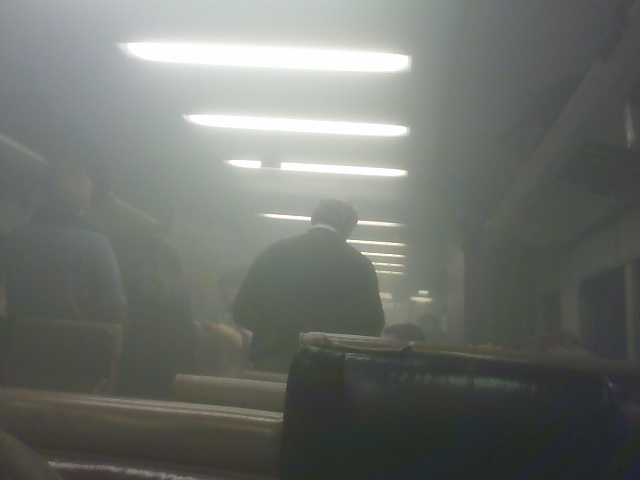
It was a typical Thursday, mid-afternoon, when Metro-North train #1540 pulled out of Grand Central on time at 3:34 pm, heading for New Haven. But this train’s journey on January 26th was to be anything but normal.
As recounted by an eye-witness, here is what happened.
Snaking its way through the underground yards, the train moved toward the Park Avenue tunnel when passengers in the fourth car of the eight car train started smelling smoke. Though they didn’t know it, a traction motor on the 1994-built M6 car, one of the newest in our aging fleet, had caught fire.
There were no flames, but there surely was smoke, not only in the fourth car but the three others that followed it. As that smoke grew thicker, being pumped into the cars by the ventilation system, passengers started coughing… and looking for help.
Because there is no intercom system on our trains, one of the passengers reached up to the ceiling and pushed the conductor buzzer system used to communicate with the motorman driving the train. A voice came over the PA system and, rather than explaining the smoke condition and what was being done to get help, told them to “lay off of the buzzer!”.
By now the train had stopped, still underground. A conductor moved forward, looking to trip the circuit-breakers for the burning motor and to shut off the HVAC fans still pumping acrid smoke into the cars. When that was finally accomplished, passengers were told to “move forward” to the unaffected cars. The train continued north through the tunnels to 125th Street.
Finally arriving at the above-ground station eight minutes later, the doors opened and the train was evacuated. Another train was dispatched from GCT to pick up the stranded passengers and they continued on their journey. There were no injuries but lots of rattled nerves.
This is at least the third such fire on Metro-North New Haven line trains in recent years. None got much publicity. Were it not for an eye-witness to this fire (who was also equipped with a cell-phone camera) who contacted the Commuter Council, this incident might never have gained attention. (Metro-North initially told me they had no reports of a fire… but there had been a “smoke condition”. Well, where there’s smoke…)
It will be at least two to three more years before our new M8 cars are in service, so what do I say to commuters who ask: Is it safe to ride Metro-North existing fleet of 30+ year old cars? What if this smoky fire had been a terrorist attack? Was “lay off the buzzer” the best the railroad could say to panicked passengers in a smoke-filled car? Will there be more such incidents, and if so, how can we handle them better?
The Commuter Council will be following up on this case with the authorities, and I’ll let you know what we find.
-----------------------------------------------------------------------
JIM CAMERON has been a commuter out of Darien for 14 years. He is Vice Chairman of the CT Metro-North / Shore Line East Rail Commuter Council, and a member of the Coastal Corridor TIA and the Darien RTM. You can reach him at jim@camcomm.com or www.trainweb.org/ct . For a full collection of “Talking Transportation” columns, see www.talkingtransportation.blogspot.com
January 19, 2006
"Free Parking Isn't Free"
Our obsession with automobiles is not only creating gridlock and ruining the quality of our air, but its eating up our real estate and sending land costs upward. Because, once we drive our cars off the crowded highways, we assume it’s our constitutional right to find “free parking”.
For decades, city planners and zoning regulations have shared with Detroit in a conspiracy to deliver on that dream. Consider the following:
According to the industry standard-setting Institute of Transportation Engineers, there are 266 kinds of businesses which should be zoned to require a minimum amount of parking. Quoting from the ITE “bible”, convents must have one parking space for every ten nuns in residence. Hello? The residents aren’t going anywhere! Why do they need parking? Couldn’t the convents find better use for their land?
Or consider hotels. Why are parking regulations based on requiring enough parking for the few nights each year when the hotel is sold out, rather that the majority of nights when occupancy is 50% or less? Would we require a movie theater to require parking for an every-seat-filled blockbuster when its more typical offerings fill far fewer seats?
Just drive up the Post Rd and see for yourself. Due to zoning regulations, many shopping malls devote 60% of their land to parking and only 40% to buildings. Imagine what that does to the costs of what they sell.
Desperate to attract folks back to their decaying downtowns, some cities are putting more land into parking than to all other land uses combined. A Buffalo City Council member commented a few years ago: “There will be lots of places to park. There just won’t be a whole lot to do there.”
In fact, the cities that have done the best jobs of economic revlitalization aren’t the ones that provided the most parking… they’re the ones that provided the least. The vitality of towns and cities requires people… walking the streets, going into shops and interacting… not scurrying from car to shop to car to home.
In his new book “The High Cost of Free Parking”, UCLA’s Donald Shoup recounts the following tale of two cities:
Both San Francisco and LA opened new concert halls in recent years. The one in LA included a $10 million, six story parking garage for 2,100 cars. In San Francisco there was no parking built… saving the developers millions. After each concert, the LA crowd heads for their cars and drives away. But in San Francisco, patrons leave the hall, walk the streets and spend money in local restaurants, bars and bookstores. Guess which city has benefited most from its new arts center?
Why are Connecticut towns slaves to antiquated zoning mentalities that assume all humans come with four tires rather than two legs? Why do we waste precious land on often-empty parking spots instead of badly needed affordable housing?
Clearly, our transportation planners need to work much more closely with economic developers to rethink what it is that we need in our cities and towns. We have become mindless slaves to car-obsessed planners for whom no vista is better than miles of open asphalt, be it highways or parking spaces.
--------------------------------------------------------------
JIM CAMERON has been a commuter out of Darien for 14 years. He is Vice Chairman of the CT Metro-North / Shore Line East Rail Commuter Council, and a member of the Coastal Corridor TIA and the Darien RTM. You can reach him at jim@camcomm.com or www.trainweb.org/ct . For a full collection of “Talking Transportation” columns, see www.talkingtransportation.blogspot.com
For decades, city planners and zoning regulations have shared with Detroit in a conspiracy to deliver on that dream. Consider the following:
According to the industry standard-setting Institute of Transportation Engineers, there are 266 kinds of businesses which should be zoned to require a minimum amount of parking. Quoting from the ITE “bible”, convents must have one parking space for every ten nuns in residence. Hello? The residents aren’t going anywhere! Why do they need parking? Couldn’t the convents find better use for their land?
Or consider hotels. Why are parking regulations based on requiring enough parking for the few nights each year when the hotel is sold out, rather that the majority of nights when occupancy is 50% or less? Would we require a movie theater to require parking for an every-seat-filled blockbuster when its more typical offerings fill far fewer seats?
Just drive up the Post Rd and see for yourself. Due to zoning regulations, many shopping malls devote 60% of their land to parking and only 40% to buildings. Imagine what that does to the costs of what they sell.
Desperate to attract folks back to their decaying downtowns, some cities are putting more land into parking than to all other land uses combined. A Buffalo City Council member commented a few years ago: “There will be lots of places to park. There just won’t be a whole lot to do there.”
In fact, the cities that have done the best jobs of economic revlitalization aren’t the ones that provided the most parking… they’re the ones that provided the least. The vitality of towns and cities requires people… walking the streets, going into shops and interacting… not scurrying from car to shop to car to home.
In his new book “The High Cost of Free Parking”, UCLA’s Donald Shoup recounts the following tale of two cities:
Both San Francisco and LA opened new concert halls in recent years. The one in LA included a $10 million, six story parking garage for 2,100 cars. In San Francisco there was no parking built… saving the developers millions. After each concert, the LA crowd heads for their cars and drives away. But in San Francisco, patrons leave the hall, walk the streets and spend money in local restaurants, bars and bookstores. Guess which city has benefited most from its new arts center?
Why are Connecticut towns slaves to antiquated zoning mentalities that assume all humans come with four tires rather than two legs? Why do we waste precious land on often-empty parking spots instead of badly needed affordable housing?
Clearly, our transportation planners need to work much more closely with economic developers to rethink what it is that we need in our cities and towns. We have become mindless slaves to car-obsessed planners for whom no vista is better than miles of open asphalt, be it highways or parking spaces.
--------------------------------------------------------------
JIM CAMERON has been a commuter out of Darien for 14 years. He is Vice Chairman of the CT Metro-North / Shore Line East Rail Commuter Council, and a member of the Coastal Corridor TIA and the Darien RTM. You can reach him at jim@camcomm.com or www.trainweb.org/ct . For a full collection of “Talking Transportation” columns, see www.talkingtransportation.blogspot.com
January 08, 2006
The Lessons of California
While we all love to mock what passes for traffic in California, the Golden State is making progress in improving its transportation mess and may even give us a few ideas. Consider the following, which I recently observed on a trip west:
1) Commuter Rail & Amtrak: The trains are full, schedules are frequent and ridership is still climbing. Clean, modern, low-cost commuter trains in the LA area are so popular the operating agency is scouring the country looking for used rail cars to add to their fleet. Maybe they’d like some of our used Virginia cars, still sitting idle on a siding in New Haven?
2) Trolleys: You can now get from Long Beach to Pasadena by trolley, not to mention the subway from downtown to Hollywood. The trains are fast and gaining in ridership. In San Diego, the trolley now has three lines, including the popular run to the Mexico border. Cars crossing back into the US wait up to two hours to clear Customs while pedestrians cross in ten minutes.
3) Freeways: Yes, they’re crowded, but they’re well signed and drivers obey the traffic rules. Best of all, there are few trucks in rush hour as they are offered incentives to move their goods at night.
4) Electric Cars: No longer are big muscle cars or exotic foreign sports cars the prestige ride. Now, its electric cars. Not only is the gas mileage better but they get priority parking spaces and can travel in car pool lanes with only one passenger.
5) Traffic Information: In the San Francisco Bay area, you can dial 511 on any cellphone and get instant traffic information. Tell the automated system your starting point, destination and desired route and you’ll get the latest information on travel times and any delays. Connecticut lawmakers have been calling for a similar system here for years, to no avail.
6) Reversible Lanes: San Diego has had reversible rush-hour lanes on some freeways for more than a decade… in-bound in the AM, outbound in the PM. We have nothing similar in Connecticut.
7) Toll Roads: Not all freeways are free. Some of the most heavily traveled roads in LA are private toll-roads, by-passing the free interstates. Fares are collected electronically without stopping and can be changed, depending on demand. While “value pricing” is already in effect in New Jersey and on the George Washington Bridge, we in Connecticut don’t yet have the political will to embrace this solution to our highway mess.
8) Air Quality: Despite the immense number of cars on the roads, stiff environmental regulations, in place for many years, California has significantly reduced air pollution. Many days the air is cleaner in LA than along I-95 in Stamford.
All is not perfect in the Golden State. And their 12 lane freeways are not a solution I’d suggest we consider. But next time you joke about “LA style traffic”, think twice. Pretty soon they’ll be joking about us!
-------------------------------------------------------------------------------
JIM CAMERON has been a commuter out of Darien for 14 years. He is Vice Chairman of the CT Metro-North / Shore Line East Rail Commuter Council, and a member of the Coastal Corridor TIA and the Darien RTM. You can reach him at jim@camcomm.com or www.trainweb.org/ct . For a full collection of “Talking Transportation” columns, see http://www.talkingtransportation.blogspot.com/
1) Commuter Rail & Amtrak: The trains are full, schedules are frequent and ridership is still climbing. Clean, modern, low-cost commuter trains in the LA area are so popular the operating agency is scouring the country looking for used rail cars to add to their fleet. Maybe they’d like some of our used Virginia cars, still sitting idle on a siding in New Haven?
2) Trolleys: You can now get from Long Beach to Pasadena by trolley, not to mention the subway from downtown to Hollywood. The trains are fast and gaining in ridership. In San Diego, the trolley now has three lines, including the popular run to the Mexico border. Cars crossing back into the US wait up to two hours to clear Customs while pedestrians cross in ten minutes.
3) Freeways: Yes, they’re crowded, but they’re well signed and drivers obey the traffic rules. Best of all, there are few trucks in rush hour as they are offered incentives to move their goods at night.
4) Electric Cars: No longer are big muscle cars or exotic foreign sports cars the prestige ride. Now, its electric cars. Not only is the gas mileage better but they get priority parking spaces and can travel in car pool lanes with only one passenger.
5) Traffic Information: In the San Francisco Bay area, you can dial 511 on any cellphone and get instant traffic information. Tell the automated system your starting point, destination and desired route and you’ll get the latest information on travel times and any delays. Connecticut lawmakers have been calling for a similar system here for years, to no avail.
6) Reversible Lanes: San Diego has had reversible rush-hour lanes on some freeways for more than a decade… in-bound in the AM, outbound in the PM. We have nothing similar in Connecticut.
7) Toll Roads: Not all freeways are free. Some of the most heavily traveled roads in LA are private toll-roads, by-passing the free interstates. Fares are collected electronically without stopping and can be changed, depending on demand. While “value pricing” is already in effect in New Jersey and on the George Washington Bridge, we in Connecticut don’t yet have the political will to embrace this solution to our highway mess.
8) Air Quality: Despite the immense number of cars on the roads, stiff environmental regulations, in place for many years, California has significantly reduced air pollution. Many days the air is cleaner in LA than along I-95 in Stamford.
All is not perfect in the Golden State. And their 12 lane freeways are not a solution I’d suggest we consider. But next time you joke about “LA style traffic”, think twice. Pretty soon they’ll be joking about us!
-------------------------------------------------------------------------------
JIM CAMERON has been a commuter out of Darien for 14 years. He is Vice Chairman of the CT Metro-North / Shore Line East Rail Commuter Council, and a member of the Coastal Corridor TIA and the Darien RTM. You can reach him at jim@camcomm.com or www.trainweb.org/ct . For a full collection of “Talking Transportation” columns, see http://www.talkingtransportation.blogspot.com/
Subscribe to:
Posts (Atom)
YOUR NEXT CAR WILL BE A LUXURY
It’s been a busy week on the transportation beat. Not much of it good: CHEAPER CARS? The US Dept of Transportation is rolling ...

-
 Taking mass transit is great. But when you step off your train or bus, what do you do to get to your final destination? Increasingly, ...
 -
 Some people say I’m a curmudgeon with never a nice thing to say about Metro-North or the CDOT… always complaining… too negative. Well, t...
 -
Much has been written in recent weeks about allowing bicyclists to bring their vehicles on board Metro North commuter trains, and I wanted t...