November 27, 2019

"Getting There" - 2020 Hindsight

As we review the details of Governor Lamont’s CT2030 transportation plan, I have a strange sense of déjà vu.  Haven’t we been through all this before?

Journey back with me to 1999 when the famous Gallis Report warned that southwestern Connecticut’s transportation woes were strangling the entire state.  If something wasn’t done, they warned, we would become “an economic cul de sac” in the burgeoning northeast.

The solution?  Yet another study, this one undertaken by Wilbur Smith Associates for SWRPA, the SouthWest Regional Planning Agency (now part of WestCOG). The report specifically looked at “congestion mitigation”, i.e. doing something about our traffic problems.

The $903,000 report was submitted in February 2003 and was titled “Vision 2020”.  You see the pattern… Vision 2020 morphs into CT2030?

Rereading the report I am struck with its many good ideas, a few of which actually came to pass:

Land Use Review:   The idea of T.O.D. (transit oriented development) has been embraced throughout the state with towns and cities planning for dense (hopefully car-free) developments near transit hubs.

More Rail Station Parking:   Also some progress, though many towns still have a 6+ year wait for annual permits.  And 20 years ago who’d have even imagined apps like Boxcar or Uber?

More Bike & Pedestrian Options:    We now have more sidewalks and bike paths as well as bike racks on buses and Metro-North.

But other “low hanging fruit” ideas still haven’t happened, like…

·       FlexTime, Staggered Work Hours and Vanpools to lighten the rush hour.  Next time you’re stuck in traffic look around:  it’s almost all SOV’s (single occupancy vehicles).

·       A “Smart Card” universally accepted for payment on all public transit.  And free transfers from buses to trains.

·       A “Weigh In Motion” system to monitor trucks without long queues at seldom-open weigh stations.

But never addressed were the big (expensive) ideas like:

·       Ramp metering, like they have in California, to stop cars from piling onto I-95 at will adding to the crush.

·       Closing some interchanges to make I-95 a truly interstate highway, not a local shortcut.
·       Adding a “zipper lane” to I-95 heading west in the AM and east in the PM… with tolls!
·       Running BRT (bus rapid transit) along the Route One corridor

·       Double tracking the Danbury branch of Metro-North.

·       Start a “feeder barge” system to bring shipping containers from NJ to New England by water, not truck.

·       Resume rail freight service by adding a rail bridge across the Hudson River.
·       Widen I-84 and Route 7 to four lanes.

·       Study the idea of high speed ferry service along the coast.

Haven’t we heard all this before?  How many of these ideas are posed again Lamont’s CT2030?  A Lot of them.

We are not lacking in ideas, just political will.  For decades the legislature has been unwilling to commit resources to our transportation infrastructure and economic future, instead wasting millions on more and more studies of the same problems.

All of these big ideas take money… big money.  But the “No Tolls CT” folks have tapped into residents’ cynicism that anything in terms of new revenue will be misspent.  And they’ve so intimidated lawmakers with threats of “Vote for Tolls, Lose at the polls” that even the bravest members can’t muster the courage to do the right thing.

Posted with permission of Hearst CT Media


November 18, 2019

"Getting There" - Super Trains

What do Ayn Rand, Hollywood and Adolph Hitler have in common?

They all dreamt of building super-trains!

Maybe it was because their visions for giant, high-speed trains came before the era of cheap flights moving large numbers of people over great distances, but each of them had a grandiose vision of fast, luxurious rail travel.

In her 1957 novel “Atlas Shrugged”, Rand made the construction of a coast-to-coast train, “The Taggart Comet”, central to the plot of her dystopian America set some time in the future.  In an era of crumbling infrastructure, the construction of an eight mile long rail-tunnel under the continental divide saw mismanagement lead to a fatal passage, killing all on board.

Fast forward 22 years and NBC was still dreaming of high-speed, transcontinental rail travel, this time on “Supertrain”.  This fictitious nuclear-powered cruise-ship-on-rails would zoom from New York to Los Angeles in 36 hours at a cruising speed of 190 mph.

Equipped with a swimming pool, disco, infirmary and shopping center, the dreamt-of double-decker train was so big it had to run on a broad-gauge track.  One-way tickets in a roomette were $450.

The life-sized set for the show’s shooting looked tacky, and the few cutaway shots of the $10 million Supertrain scale-model cruising across the country were unconvincing.  Of course, the show wasn’t about the train but the people who rode it, like a “Loveboat” on land.  The vision of TV mogul Fred Silverman, the show was a disaster and lasted only one season.

Mind you, by 1979 when Supertrain was taking to air, Amtrak was debuting its own double-deck long distance trains, dubbed Superliners.  The cars still run today on such trains as The Empire Builder (Seattle to Chicago) and the California Zephyr (San Francisco to Chicago).  But these trains are more ballast than bullet, with a (rarely achieved) top speed of 100 mph.  And though they do offer a dining car and glass-topped observation lounge, there is no pool or disco.

What inspired Rand, NBC and Amtrak to such rail dreams?  It might have been Adolph Hitler.

Early during World War II, Hitler was thinking and building big.  Berlin was to be rebuilt as Welthauptstadt Germania, capital of the world. And to move people across conquered Europe, the network of Autobahns was to be complimented with the Breitspurbahn, translated as broad-gauge railroad, with trains twice as wide as standard gauge.

The locomotives’ designs ranged from traditional steam to gas turbine, but the rail cars would make Supertrain pale in comparison.  Each double-deck car would be 138 feet long, 20 feet wide and 23 feet tall, the size of a small house.

The train would be a third of a mile long carrying 2000 to 4000 passengers at 120 mph.  On board would be a 196-seat cinema, barbershop, sauna and a dining car for 176.  Daytime and night seating (and sleepers) would be offered in three classes.  Additionally a single car could carry up to 450 slave laborers.  There was also room for several 20 mm anti-aircraft guns.

Hitler had a team of 100 top engineers working on the railroad’s design right up until the end of the war, though a prototype was never built.

Today we have any number of super-fast trains, but none as large as earlier generations had imagined.

Posted with permission of Hearst CT Media

"Getting There" - Coffee, Tea ... or E-Coli

You should never drink coffee or tea prepared on an airplane:  you may get very sick.

That’s the bottom line to recent studies (by Hunter College’s NYC Food Safety Center) of the safety of airplanes’ water tanks which, it turns out, can be harboring some nasty contaminants such as e coli and coliform.  Some suggest you shouldn’t even wash your hands in on-board water.

Airlines are only required to flush and clean their on-board water tanks four times a year.  But when they fly to exotic destinations and get serviced between flights, they take on local water which may not meet US standards.  The tanks aren’t emptied and cleaned, just topped-off, leaving the nasty stuff at the bottom. And those tanks can often sit long periods (think overnight) between fillings.

The airlines say there isn’t time between flights to do more than clean the cabin, off-load and load baggage and get their expensive jets back in the air, making money.

Back in 2011 the EPA instituted the Airline Drinking Water Rule (ADWR) which was to “ensure that safe and reliable drinking water is provided to aircraft passengers and crew.”  But a year later, one in ten aircraft tested still showed signs of coliform.

Coliform itself won’t make you sick but it’s often a sign of other dangerous bacteria lurking in your drinks: viruses, protozoa and multicellular parasites.

Some airlines, like Southwest which has one of the best water safety records, disinfect their tanks with ozone.  But while OCDC flyers may swab their seatback tables with disinfectant wipes, there’s not much they can know (or do) about those hidden water tanks… or your fellow passengers spewing germs into the recirculated air.  Maybe you should bring a surgical mask, too?

It’s also not very reassuring to learn that the EPA has rarely, if ever, levied a fine against those airlines failing inspections.  Even airlines failing quarterly water sample tests don’t have to shut down their water use for 24 hours.  Huh?

The Hunter College study ranked the top ten domestic airlines’ water safety.  Top scores for the cleanest water went to Alaska and Allegiant with scores of 3.3 on a scale of 5 (where 5 is best).  The major carriers like Delta, American and United and got scores of 1.6, 1.5 and 1.2  respectively.  At the bottom of the rankings, with scores of just 1, were JetBlue and Spirit.

You absolutely need to hydrate, especially on longer flights, but you should either BYO bottled water or drink the airlines’ water distributed in flight, but only if it’s bottled.  That coffee or tea you’re offered in-flight is not made with bottled water.  Plus, the caffeine in tea or coffee only dehydrates you further.

On the railroads I can remember the olden days when rail passengers could get water from a cooler in each car, quaffing their thirst with tiny, triangular paper cups dispensed next to the spigots.  Not anymore.  Amtrak even reminds passengers not to drink restroom sink water.

On Metro-North there are no water spigots, though each train does carry emergency “boxed” water in case of a breakdown and lengthy delays.  But even those supplies have a five year safety limit.

Bottom line:  don’t be paranoid but do be safe.  Bring your own water, even if it means carrying any empty bottle through TSA for filling at a water fountain.

Posted with permission of Hearst CT Media


November 04, 2019

"Getting There" - The Folly of Fast Ferries

Just when I thought Governor Lamont was getting it together to launch a thoughtful, considered “take two” on his transportation vision… bam!  Along comes another nonsensical idea.

It wasn’t enough that he tried to sell us on the zany, physically / fiscally impossible 30-30-30 vision of faster train speeds, now he is (literally) refloating the idea of “high speed” ferry service from Bridgeport and Stamford to NYC.

Such ferry service wouldn’t take cars off of I-95.  Those drivers aren’t going where the ferry does.  And if they haven’t already opted for the train, why would they ever take a ferry?

As my Hearst colleague Kaitlyn Krasselt reported, the lure of Federal funding is what’s getting the Lamont team to revisit the often studied, always rejected idea of aquatic commutation.  Since 2006 I have written about why ferries will never work here.  But let me remind you of the high points:

·       “High speed” ferries aren’t fast.  They can only go 29 mph in open waters, half the speed of a Metro-North train.  Speeds in excess of 30 mean higher operating costs for additional highly skilled crew.

·       They only carry 149 passengers (vs 1000 on a train) and are gas-guzzling polluters (vs clean electric trains). 

·       A fleet of two such ferries might make two round-trips a day (vs every-20 minute rush hour trains).

·       They can’t operate in all weather.

·       The fares would be at least double those of the train and they’d still need huge subsidies to attract operators.

NY State and Federal subsidies of $4.7 million were wasted on a ferry from Yonkers to NYC which ran for four years.  At its peak it carried just 90 passengers a day paying $8 each way… subsidized at $50 per ride.

Or consider Glen Cove LI’s experience with failed ferries.

In 2001 that bedroom community just 28 miles from NYC on the LIRR, began ferry service to NYC at fares pretty close to those charged on the train.  It failed after a year due to low ridership and despite $1 million subsidy by the MTA.

In the “summer of hell” in 2017 when track work at Penn station delayed trains, the service resumed with two boats each rush hour carrying fewer than 80 passengers between them.  The subsidies for the July to September runs totaled over $1.5 million.  That’s a $257 subsidy per passenger per trip.

In 2016 Glen Cove built a stylish new ferry terminal and dock costing $16.6 million using a Federal grant.  But aside from the summer of 2017, the city has been unable to find a ferry operator to resume service.

So guess what:  the Fed’s asked for their money back.

Glen Cove had until January 2019 to resume ferry service or refund Washington its money.  After an extension, the city Council voted 4-3 to hire a new, heavily subsidized ferry operator… not because they liked their proposal but because the alternative of paying back $16 million was even worse.

So if the Lamont transportation team is so excited about using Federal money to study, build or even start a private – public partnership for ferry service from Connecticut they should consider the consequences.  Federal money may seem “free”, but if it locks you into a money-losing, heavily subsidized, under-utilized fast ferry for Fat Cats going to Wall Street, the long-term cost could be huge.

Posted with permission of Hearst CT Media

October 27, 2019

"Getting There" - Reading Old Timetables

I love reading timetables.  Not the new ones on smartphone apps, but the old printed ones.  Reading about a train or plane’s journey on paper is almost like taking the ride itself.

Growing up in Canada I was fascinated with the two major passenger railroads, the quasi-government owned “crown corporation” Canadian National Railroad (CNR) and the private Canadian Pacific Railroad (CPR).  Both ran transcontinental trains from Montreal and Toronto to Vancouver, a journey of 70+ hours… if they were on time.

I wondered why the CPR’s streamliner “The Canadian” left Toronto at 4:15 pm while its CNR competitor “The Super Continental” left at 6 pm.  And why did the CNR’s later-leaving train arrive 4 hours earlier into Vancouver than the CPR’s?   Reading the 31 stop itinerary explained why:  they took much different routes through the Canadian Rockies.  The CPR’s more southerly, scenic route was the highlight of the trip so they timed the journey for daylight hours.

Canada has two official languages, English and French, so it was by reading those timetables I learned that “quotidien” meant daily, “repas” meant meal and “douane” translated as customs, as in crossing an international border.

Fast forward fifty years and I’m still intrigued with old New Haven Railroad timetables, comparing that crack (private) railroad’s speeds with those of present-day Metro-North and Amtrak.  How did the New Haven make it from New Haven to Penn Station in 90 minutes while it today takes Amtrak 109 minutes?

But old timetables contain more than train times.  They also talk about the entire travel experience.

Did it really (in 1955) cost just $7.75 to go from Boston to NY in coach ($14 in a lower berth, $13 in an upper)?  The old timetables also list the trains’ “consists”… what kind of rail cars made up each run: coaches, Pullmans, Parlor-Lounge car (some equipped with two-way radio telephones) and diners.

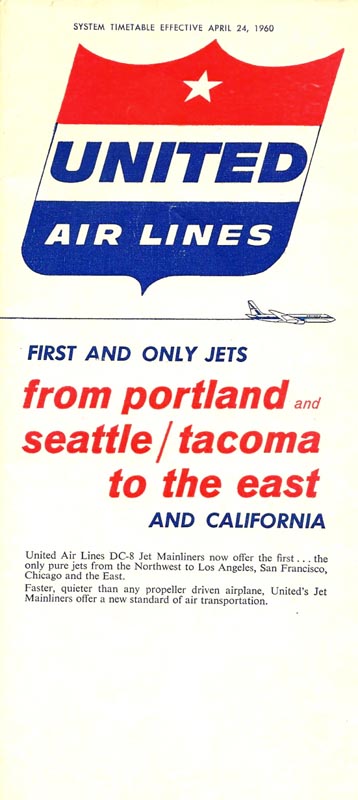
On the aviation side I remember when airlines published their own timetables too, often promoting their advanced aircraft:  American airline’s 707 Astrojet, United’s DC-8 Mainliner and Braniff Airlines “Conquistador” DC-6

The illustrations were always of well-dressed travelers smiling as they boarded their planes using ground-stairs, long before airports had jetways.  The seating looked roomy and comfortable as well-coiffed stewardesses served elaborate meals.

But the grand-daddy of all airline timetables was the OAG, the Official Airlines Guide, a phone-booked-sized (look it up, kids) compendium of every flight in the country.  As a one-time road warrior I even subscribed to the “pocket” version which was about an inch thick.  Miss a flight?  Your OAG would show you the alternatives.

What I enjoyed most reading the OAG’s railroad-style timetable wasn’t the flight times, and later, the on-time performance percentage, but the kind of aircraft used on each flight.  I took a liking to TWA’s iconic L-1011’s and avoided American’s DC-10’s after the deadly 1979 crash at O’Hare.

And after 9/11 I always opted for any airline flying Airbus equipment.  The reason?  The 9/11 terrorists had gone to flight school to learn how to fly traditional “yolk” flight controls, but only the airlines’ own simulators could train pilots on the Airbus fly-by-wire joystick controls:  i.e., Airbus jets were not going to get hijacked.  Or so I hoped.

Today there are no paper timetables.  All the information is online and on my phone… handy, but not as romantic.

Posted with permission of Hearst CT Media


October 17, 2019

"Getting There" - Connecticut's Own Igor Sikorsky

Have you ever flown in a helicopter?  They seem such a glamorous (if expensive) way to travel, bypassing the traffic enroute to the airport or sightseeing over rugged terrain.

But do you know that the helicopter had its first flight ever right here in Connecticut, the creation of Russian immigrant and inventor Igor Sikorsky, 80 years ago.

Sure, Leonardo da Vinci made early drawings of a vertical flying machine, but that was in the 1480’s.  And kids had been playing with hand-turned, propeller-driven toys for centuries before that.

Sikorsky drew his earliest concept drawings of a helicopter years before the Wright brothers ever flew at Kitty Hawk.  But when he fled Russia with his family, it was fixed-wing aircraft that gave Sikorsky his start in aviation.

At the age of 21 he designed his first airplane, the S-1, a single-engine pusher biplane. Twenty-three designs later he built the S-42 flying boat, made famous by Pan American as “The Flying Clipper”.  The four-engined craft had a range of 1200 miles carrying 37 passengers by day or 14 by night in berths, cruising at 170 mph.

Even as Pan Am was opening literally over-seas markets, Sikorsky was still working on his dreams of a helicopter.  At his plant in Stratford his VS-300 made its first flight, albeit tied to the ground, in September of 1939.

A 1942 version, the Sikorsky R-4, became the first mass-produced helicopter, quickly adopted by the armed forces of the US and UK. It had only one crew member, could only carry 500 pounds, but had a range of 130 miles flying 65 mph at up to 8000 feet.

Flash forward to the present and Sikorsky’s old company, now part of Lockheed Martin, still produces helicopters. Sikorsky’s successor companies, then part of United Aircraft Corp, even designed the short-lived (1968 -1976) Turbotrain, powered by a Pratt & Whitney turbine “jet engine”.  The train could make the 230 mile New York to Boston run in three hours and 39 minutes.  Today’s Acela can do the same run in no less than 3 hours 55 minutes.

In a competition with the electric-powered Metroliner in 1967, the Turbotrain hit 170 mph, a land speed record for a gas turbine-powered rail vehicle. Acela does no better than 145 mph.

Today’s modern helicopters come in all sizes and speeds… from the beefy Seahawk SH-3 “Sea King” which can carry five tons over 600 miles at 166 mph… to “personal” helicopters for one person flying 60 miles at 80 mph.

For helicopter fans, New York’s east-side heliports at Wall Street and 34th Street offer the chance to see luxury craft in action, some privately owned, others offering passenger service.  BLADE Helicopters will get you to the Hamptons from midtown in 33 minutes starting at $695 one-way.  

In the 1960’s NY Helicopter flew from the NY airports to the top of the Pan Am building. I took that flight once, transferred to an elevator and walked onto a train in Grand Central.  For awhile they even choppered to Stamford’s heliport on Canal Street in the South End.

Much has changed in aviation in the last 80 years since Sikorsky’s first helicopter took to the air.  And to think that it all started here in Connecticut.

Posted with permission of Hearst CT Media


October 10, 2019

"Getting There" - Amtrak's Next Acela

I’m a big fan of high speed trains, which means I often ride Amtrak’s Acela to Boston or Washington.  It’s the best train in North America, though it pales in comparison to true HSR (high speed rail) in Europe or Asia.

While Acela can hit a top speed of 150 mph, it does so on only 34 of the 457 miles between DC and Boston.  Over the entire run, what with congestion and station stops, it only averages about 70 mph.

But its 20 runs a day are highly popular, especially with business travelers on expense accounts (the fares are roughly double usual coach fares).  The trains are often sold out and, depending on whose accounting you trust, actually make a profit for the quasi-public corporation, carrying 3.4 million passengers a year:  25% of Amtrak’s total revenue.

As well maintained as the Acela fleet is, it’s getting old.  The trains have been running almost 20 years old and they’re too small, carrying just 304 passengers per trip.  Compare that to the Eurostar from London to Paris (750 passengers per train) or Japan’s Shinkansen from Tokyo to Osaka (1300 passengers).

So, Amtrak is building the next generation of Acela.

When it was shopping for the first Acela, Amtrak tested two European designs… the Swedish X2000 tilt-train and the German ICE Train.  Liking elements of both, they opted for neither, instead going for a brand new design custom built by Bombardier and Alstom.  This time they’re going with a proven design modeled after Alstom’s French TGV and Italy’s Pendolino.

The new Acelas will carry 378 passengers and will be built with aluminum bodies.  They’ll be capable of speeds of 220 mph but will probably never achieve those rates.  Given the old roadbed and signal system, they’ll probably max out at 160 mph on the small portion of track that can handle it.  Think of a Ferrari trying to drive on a potholed I-95.

So while they’ll be no faster than the existing Acelas, they may be more comfortable. Using an active tilting system they’ll be able to go faster through the Northeast’s many curves, without tossing passengers or their drinks into the aisle.

Each of the 28 trainsets will have engines at each end pulling and pushing nine passenger cars.  If ridership remains strong, three additional articulated coaches can be added to each trainset.

The seating will be Business and First Class (Coach is only for the slower and cheaper Northeast Corridor trains).  Each plush leather seating row will have power and USB plugs.  The Café Car will be snazzier, too.

The initial trainsets are being built now at Alstom’s plant in Hormel NY.  Testing should start this fall at the FRA’s test track in Pueblo CO and, if all goes well, on the Northeast Corridor itself by December.

Assuming no problems, the new Acelas should enter commercial service in 2021 with all 28 sets delivered by 2022, at which point Amtrak will retire the original models.

Mind you, these new cars are not cheap:  about $2 billion for the 28 trains, making them Amtrak’s most expensive purchase ever.  Each train will cost about double what its European counterparts do because of FRA requirements for crash-worthiness:  the engines are built like a tank to sustain any impact in a crash.

So hang in there rail fans.  Something new is coming from Amtrak to a train line near you!

Posted with permission of Hearst CT Media.

PT BARNUM’S BRIDGEPORT WAS NO CIRCUS

When you think of P.T. Barnum your first thought is probably about his circus, or maybe his museum of oddities in 1840’s New York City.   ...